Artificial intelligence has evolved far beyond simple chatbots and automation tools. Today, AI Agents are becoming one of the most significant innovations in modern workplaces. They can understand tasks, make decisions, learn from interactions, and complete complex workflows with minimal human intervention.
From customer support and marketing to healthcare and software development, AI Agents are helping businesses improve productivity, reduce repetitive work, and make better decisions. Instead of replacing humans, these intelligent systems are increasingly working alongside people to improve efficiency and create new opportunities.
As businesses continue adopting intelligent automation, understanding Artificial Intelligence Agents has become essential for professionals, business owners, and technology enthusiasts. In this guide, you will learn what AI Agents are, how they work, their benefits, challenges, real world applications, and why they are shaping the future of work.
What Are AI Agents?
AI Agents are intelligent software systems that can observe their environment, analyze information, make decisions, and perform tasks with little or no human supervision.
Unlike traditional automation tools that follow predefined rules, Artificial Intelligence Agents can adapt to changing situations, learn from previous experiences, and solve more complex problems. They combine technologies such as machine learning, natural language processing, reasoning, and automation to complete tasks efficiently.
Understand user requests
It can interpret human language, understand context, and identify the best action to take.
Make decisions
Instead of waiting for instructions, AI Agents evaluate available information before choosing the most appropriate response.
Complete multiple tasks
An AI Agent can schedule meetings, answer emails, generate reports, analyze data, and communicate with other software systems automatically.
Learn continuously
Modern Artificial Intelligence Agents improve their performance by learning from previous interactions, user feedback, and newly available information.
This ability to think, plan, and execute makes Artificial Intelligence Agents far more powerful than traditional automation software.
How AI Agents Work
Although different AI Agents use different technologies, most follow a similar workflow.
Understanding the goal
The process begins when a user provides a request or objective.
For example:
“Create a weekly sales report and send it to the management team.”
Collecting information
The AI Agent gathers relevant data from connected applications, databases, documents, or cloud services.
Analyzing the data
Using artificial intelligence models, it analyzes the information to understand what needs to be done.
Planning the workflow
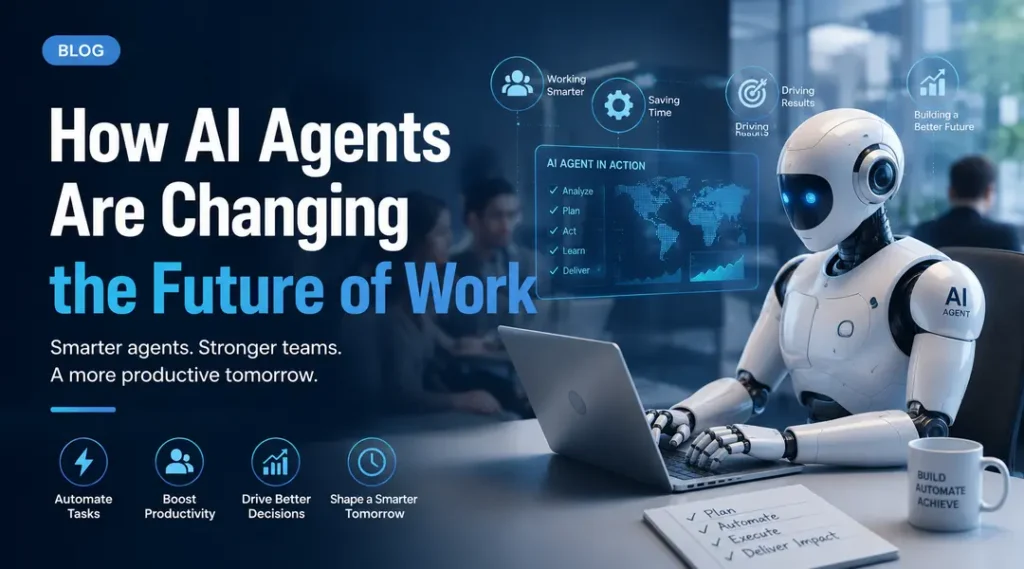
Instead of completing a single action, Artificial Intelligence Agents often create a sequence of tasks.
For example:
- Collect sales data
- Generate charts
- Write the summary
- Create the report
- Email the management team
Executing the tasks
The AI Agent performs each task while monitoring progress and adjusting if necessary.
Learning from results
After completing the task, the system evaluates outcomes to improve future performance.
This continuous improvement makes Artificial Intelligence Agents increasingly valuable over time.
Why Businesses Are Adopting AI Agents
Companies across industries are investing in AI Agents because they offer measurable improvements in productivity, efficiency, and customer satisfaction.
Increased productivity
Employees spend a significant amount of time on repetitive administrative work. AI Agents automate these routine tasks, allowing teams to focus on creative thinking, strategic planning, and problem solving.
Faster decision making
Artificial Intelligence Agents analyze large volumes of data within seconds, helping organizations make informed decisions more quickly than manual analysis.
Better customer experiences
Businesses can provide faster responses, personalized recommendations, and round the clock support through Artificial Intelligence powered customer service agents.
Lower operational costs
Automating repetitive work reduces manual effort, minimizes errors, and lowers operational expenses.
Improved accuracy
AI Agents consistently follow workflows and reduce human errors, especially in data processing, reporting, and documentation.
Real World Applications of AI Agents
AI Agents are already transforming many industries.
Customer Support
AI Agents can answer common questions, resolve issues, manage support tickets, and escalate complex cases to human representatives when necessary.
Benefits include:
- Faster response times
- Higher customer satisfaction
- Reduced support costs
- Twenty four hour availability
Marketing
Marketing teams use AI Agents to:
- Generate content ideas
- Create social media posts
- Analyze campaign performance
- Personalize customer experiences
- Improve email marketing
These capabilities help marketers focus on strategy rather than repetitive tasks.
Sales
Sales professionals benefit from Artificial Intelligence Agents that can:
- Qualify leads
- Schedule meetings
- Generate proposals
- Update customer relationship management systems
- Analyze customer behavior
This enables sales teams to spend more time building relationships.
Human Resources
HR departments use AI Agents for:
- Resume screening
- Interview scheduling
- Employee onboarding
- Policy assistance
- Performance reporting
Recruiters can save significant time while improving candidate experiences.
Healthcare
Healthcare organizations use Artificial Intelligence Agents to assist with:
- Patient scheduling
- Medical documentation
- Clinical decision support
- Treatment recommendations
- Administrative tasks
It’s professionals can dedicate more time to patient care.
Software Development
Developers increasingly rely on AI Agents to:
- Write code
- Detect bugs
- Generate documentation
- Review software
- Suggest improvements
This accelerates software delivery without compromising quality.
AI Agents vs Traditional Automation
Many people confuse Artificial Intelligence Agents with traditional automation tools, but there are important differences.
| AI Agents | Traditional Automation |
| Learn from experience | Follow fixed rules |
| Adapt to changing situations | Limited flexibility |
| Handle complex decisions | Perform repetitive tasks |
| Understand natural language | Require predefined inputs |
| Improve over time | Rarely improve without updates |
Traditional automation remains valuable for simple repetitive processes, while AI Agents are better suited for dynamic and intelligent workflows.
Benefits of AI Agents for Employees
One common misconception is that AI Agents only benefit businesses. In reality, employees can gain significant advantages as well.
Reduced repetitive work
Routine tasks like scheduling meetings, organizing files, and generating reports can be handled automatically.
Better work life balance
With less time spent on administrative work, employees can focus on meaningful and engaging responsibilities.
Improved creativity
Artificial Intelligence Agents handle repetitive processes, giving professionals more time for innovation and creative thinking.
Faster learning
AI powered assistants provide instant information, recommendations, and training resources, helping employees develop new skills more efficiently.
Better collaboration
AI Agents simplify communication by organizing projects, tracking deadlines, and sharing updates across teams.
Challenges of AI Agents
Although AI Agents provide numerous advantages, organizations should also consider potential challenges.
Data privacy
AI Agents often process sensitive business information. Strong security practices and responsible data handling are essential.
Accuracy limitations
AI generated outputs should always be reviewed by humans, especially for critical business decisions.
Ethical concerns
Organizations should ensure Artificial Intelligence systems operate fairly, transparently, and without harmful bias.
Employee training
Successful adoption requires employees to understand how to work effectively with AI technologies.
Integration complexity
Connecting AI Agents with existing software systems may require technical expertise and careful planning.
Best Practices for Using AI Agents
Businesses can maximize the value of Artificial Intelligence Agents by following several best practices.
Start with repetitive tasks
Automate high volume routine work before expanding to more complex workflows.
Keep humans involved
Human oversight remains important for reviewing decisions and maintaining quality.
Protect sensitive data
Use trusted AI platforms with strong security measures and follow data protection regulations.
Monitor performance
Regularly evaluate AI outputs to identify opportunities for improvement.
Train employees
Provide education and practical training so teams can collaborate effectively with AI Agents.
The Future of AI Agents
The capabilities of AI Agents are advancing rapidly.
Future AI Agents will likely become more autonomous, collaborative, and capable of managing complex business operations across multiple platforms. Instead of handling individual tasks, they may coordinate entire business processes while working alongside human employees.
Businesses are also expected to use multiple specialized AI Agents that communicate with one another to solve larger challenges. For example, one agent could manage customer interactions, another could analyze financial data, while another oversees inventory and logistics.
As innovation continues, AI Agents will become an essential part of digital transformation strategies across nearly every industry.
If you want to explore broader technological trends beyond workplace automation, learning about the Future of Artificial Intelligence provides valuable insights into how intelligent systems will continue evolving and influencing businesses worldwide.
Similarly, understanding the Future of Artificial Intelligence helps organizations prepare for emerging technologies, changing workforce demands, and new opportunities for innovation.
Will AI Agents Replace Human Jobs?
This is one of the most frequently asked questions.
The reality is more balanced.
AI Agents will automate many repetitive and time consuming tasks, but they are unlikely to replace human creativity, emotional intelligence, leadership, critical thinking, and complex decision making.
Instead, many jobs will evolve.
Professionals who learn to collaborate with AI Agents will likely become more productive and valuable in the workplace.
New roles are also emerging, including:
- AI workflow specialists
- AI trainers
- Prompt engineers
- AI governance experts
- Automation consultants
- AI product managers
The workforce of the future will increasingly combine human expertise with intelligent AI systems.
How to Prepare for an AI Driven Workplace
Preparing for the future does not require becoming an AI expert overnight.
Instead, professionals can focus on practical steps:
Learn AI fundamentals
Understanding how AI Agents work helps you use them effectively.
Develop problem solving skills
Human judgment remains essential in complex situations.
Improve communication
Strong collaboration skills will continue to be highly valuable.
Stay updated
Artificial intelligence evolves rapidly, making continuous learning important.
Embrace AI as a partner
The most successful professionals will use AI Agents to enhance their work rather than compete with them.
Conclusion
AI Agents are transforming the future of work by making businesses more efficient, improving customer experiences, and helping employees focus on higher value activities. Their ability to analyze information, make decisions, and automate complex workflows makes them far more advanced than traditional automation tools.
While challenges such as privacy, ethics, and workforce adaptation remain important, the overall impact of AI Agents is expected to be overwhelmingly positive when implemented responsibly.
Rather than replacing people, AI Agents are becoming intelligent collaborators that support innovation, productivity, and business growth. Organizations and professionals who embrace this technology today will be better prepared for tomorrow’s rapidly evolving workplace.
As AI continues to mature, AI Agents will play a central role in shaping smarter businesses, more efficient operations, and a more productive future for everyone.