
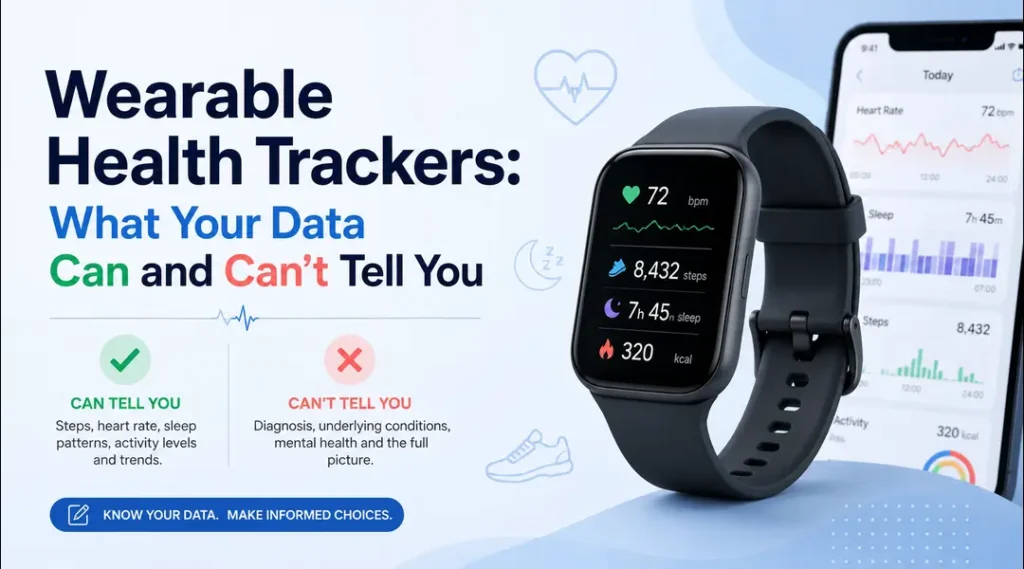
Wearable health trackers have become a simple way to keep an eye on everyday health. A smartwatch, fitness band, or smart ring can show your heart rate, daily steps, sleep patterns, activity levels, and other health metrics within seconds.
But there is an important difference between tracking a health signal and understanding what that signal means.
Wearable devices can be useful for spotting trends, building healthier habits, and giving you more information about your daily routine. At the same time, their measurements are not always perfectly accurate, and many consumer devices are not designed to diagnose medical conditions.
Research shows that wearable accuracy can vary considerably depending on the device, measurement, activity, and individual circumstances. For example, heart rate measurements can be reasonably close to reference measurements in some situations, while calorie expenditure and sleep measurements can have substantially larger errors.
Understanding these strengths and limitations can help you use Wearable Health Trackers more wisely.
What Are Wearable Health Trackers?
Wearable Health Trackers are electronic devices designed to collect health and activity information while you wear them. Common examples include smartwatches, fitness bands, and smart rings.
Depending on the device, sensors may collect information related to:
Common health metrics
- Heart rate: Measures your pulse at different times, including during exercise and rest.
- Steps and movement: Estimates how much you walk or move throughout the day.
- Sleep: Uses movement and other signals to estimate sleep duration and patterns.
- Blood oxygen: Some devices estimate blood oxygen saturation using optical sensors.
- Heart rate variability: Some devices provide HRV measurements that may be useful for understanding changes in recovery or stress patterns.
- Exercise activity: Tracks workouts, duration, distance, pace, and estimated energy expenditure.
- Temperature and other signals: Certain advanced devices can collect additional measurements, depending on their sensors and intended use.
The important point is that a wearable usually estimates or measures a specific signal. It does not automatically provide a complete picture of your health.
What Can Wearable Health Trackers Tell You?
The biggest benefit of wearable health technology is its ability to collect information consistently over time.
A single reading may not tell you much. A pattern across several days or weeks can be much more useful.
Your activity patterns
Activity tracking can help you understand how much you move during a normal day.
For example, you might discover that you are active during weekdays but spend most weekends sitting. This information can help you make practical changes to your routine.
Step counts are generally more useful as a personal activity indicator than as an exact measurement of overall fitness. Research has found that step counting can perform reasonably well on some consumer devices, although accuracy varies by device and activity.
Your heart rate trends
Heart rate monitoring is one of the more established features available on many smartwatches and fitness trackers.
You can use it to observe changes in resting heart rate, exercise response, and recovery patterns.
Research has found that some wearable devices can measure heart rate with relatively small average differences from reference measurements, but accuracy can change with exercise intensity, device design, movement, and individual factors.
A trend that consistently looks unusual may be worth discussing with a healthcare professional, particularly if you also experience symptoms.
Your sleep routine
Sleep tracking can help you understand your bedtime routine and identify changes in sleep duration.
For example, your data may show that you sleep less after late nights or that your schedule changes significantly between weekdays and weekends.
However, sleep tracking should be viewed as an estimate rather than a clinical sleep study. Research has found that consumer wearables can differ from established sleep measurement methods, including a tendency to overestimate total sleep time in some studies.
Your personal trends
Perhaps the most useful feature of a wearable is not a single number but the ability to compare your own data over time.
If your usual resting heart rate, activity level, or sleep duration changes, the trend can give you a reason to pay closer attention to your routine.
This makes wearable data particularly useful for personal health insights, rather than treating every reading as a definitive medical measurement.
What Can’t Wearable Health Trackers Tell You?
This is where responsible use becomes important.
A wearable can collect health related information without being able to explain the underlying cause.
They cannot diagnose a medical condition by themselves
A smartwatch notification or unusual measurement should not automatically be interpreted as a diagnosis.
For example, an elevated heart rate can have many possible explanations, including physical activity, stress, caffeine, lack of sleep, or other factors. A wearable does not have enough context to determine the cause on its own.
The FDA distinguishes general wellness products from products intended for clinical purposes such as diagnosis, disease monitoring, or treatment decisions. Some wearable technologies are medical devices, but that status depends on the device and its intended use.
They cannot provide perfectly accurate numbers
One of the biggest misconceptions about fitness trackers is that every number displayed on the screen is precise.
It is not.
A 2024 umbrella review of systematic reviews found considerable variation in wearable accuracy. Heart rate generally showed relatively small average error in the studies reviewed, while measurements such as energy expenditure, physical activity intensity, aerobic capacity, and sleep could have substantially larger differences depending on the circumstances.
This means a wearable should not be treated like a laboratory instrument.
They cannot explain every change in your body
Suppose your sleep score decreases for three nights. The device may show the change, but it cannot necessarily tell you why it happened.
Your routine, environment, stress, exercise, illness, travel, food, caffeine, or many other factors could influence the result.
The data provides a clue, not necessarily an explanation.
They cannot replace professional medical care
Wearables can complement conversations with healthcare professionals, but they should not replace appropriate medical evaluation.
If you have concerning symptoms or a persistent change in your health, relying solely on a wearable reading can create false reassurance or unnecessary worry.
Why Wearable Accuracy Matters
Accuracy is especially important because people often make decisions based on wearable data.
Consider calorie tracking. A person might see an estimated calorie burn and assume the number is exact. However, research has found that energy expenditure is one of the areas where consumer wearables can have significant measurement error.
The same principle applies to sleep scores, stress measurements, recovery scores, and other calculated metrics.
Instead of asking, “Is this number exactly correct?” a better question is:
“Is this measurement useful for understanding my personal trend?”
That change in perspective can make wearable data much more useful.
How to Use Wearable Health Data Wisely
Focus on trends instead of isolated readings
One unusual reading does not necessarily mean something is wrong.
Look for repeated changes over time. Comparing your current patterns with your own normal baseline can often provide more meaningful information than comparing your numbers with someone else’s.
Understand what your device actually measures
Read the manufacturer’s information about each health metric.
Some measurements are directly sensed, while others are calculated from multiple signals. A “stress score” or “recovery score,” for example, may be an algorithmic interpretation rather than a direct measurement of stress or recovery.
Understanding the difference helps you interpret your dashboard more realistically.
Use multiple signals together
A single metric rarely tells the whole story.
Instead of focusing only on steps, consider your activity, sleep, resting heart rate, exercise routine, and how you actually feel.
When several indicators change in the same direction, the overall pattern may be more informative.
Keep the human context in mind
Your wearable does not know everything happening in your life.
If you slept poorly because of travel, worked unusually long hours, or completed a difficult workout, those circumstances may explain changes in your metrics.
Health data makes more sense when it is combined with real life context.
Health Data Privacy Is Also Important
Your health information is valuable, so privacy should be part of your decision when choosing a wearable.
Before buying or using a device, check:
- What information the device collects.
- Where the data is stored.
- Whether information is transferred to a phone or cloud service.
- What permissions the companion app requests.
- Whether you can export or delete your information.
- How the company explains data sharing and privacy.
Convenience should not be the only factor when choosing wearable technology. Consider the device’s features, accuracy evidence, privacy practices, security options, and the type of information you actually need.
Wearables and the Future of Digital Health
Wearable technology is becoming an important part of the wider digital health ecosystem.
Smartwatches, rings, fitness bands, and other connected devices can provide continuous or regular information outside traditional healthcare settings. The FDA maintains a list of authorized sensor based digital health technologies that includes wearable devices designed for health parameter monitoring.
This creates opportunities for more personalized health monitoring and, in some cases, remote patient monitoring.
At the same time, more data does not automatically mean better healthcare.
The value comes from collecting useful information, understanding its limitations, protecting privacy, and using appropriate professional judgment when medical decisions are involved.
This broader shift is also connected to how AI Is Revolutionizing Healthcare, particularly through technologies that can process large amounts of health information and identify patterns that may be difficult to notice manually.
Are Wearable Health Trackers Worth Using?
For many people, yes, provided they are used with realistic expectations.
They can be valuable for:
- Building awareness of daily activity.
- Monitoring personal trends.
- Encouraging regular movement.
- Understanding sleep routines.
- Tracking workouts.
- Observing heart rate patterns.
- Supporting conversations with healthcare professionals when relevant data is useful.
Their main limitation is that they do not turn everyday health information into a complete medical assessment.
The best wearable is therefore not necessarily the one with the largest number of sensors or the longest list of features. It is the one that provides information you can understand, use consistently, and interpret responsibly.
Final Thoughts
Wearable Health Trackers can give you a helpful window into your everyday habits, activity, sleep, and selected physiological signals. Their biggest strength is continuous data collection and the ability to reveal personal trends over time.
But the numbers on your wrist are not the same as a complete medical evaluation.
Some measurements can be reasonably accurate under certain conditions, while others may have meaningful limitations. Research continues to evaluate how well consumer wearables measure different health metrics, and accuracy can vary considerably between devices and situations.
Use your wearable as a tool for awareness, not a substitute for medical judgment.
When you understand what your device can measure, what it estimates, and where its limitations lie, health tracking becomes more useful, practical, and responsible.