Artificial intelligence is changing the way people learn, work, communicate, and solve problems. For students, this change creates exciting opportunities, but it also raises an important question: what skills will actually matter in a world where AI can perform many tasks in seconds?
The answer is not simply learning how to use the latest AI tool. Students need a combination of technology skills and human abilities that help them understand AI, work with it responsibly, and make decisions that machines cannot easily replace.
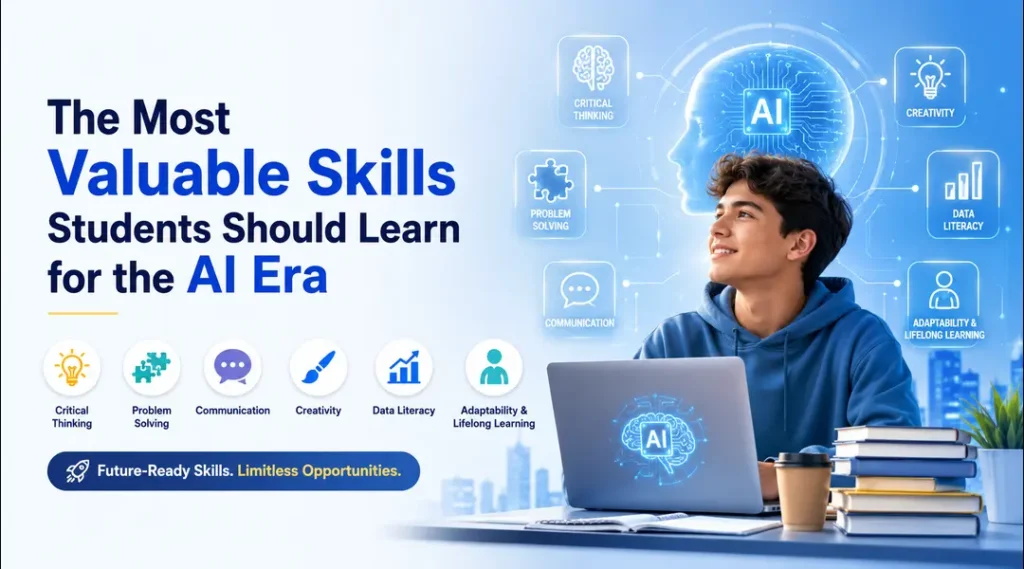
The most valuable AI skills for students are therefore broader than technical knowledge. Critical thinking, creativity, communication, problem solving, adaptability, digital literacy, and ethical judgment will become increasingly important as AI becomes part of everyday life.
This article explores the key skills students should start developing today to become confident, capable, and future ready.
Why Students Need New Skills in the AI Era
AI is already being used in education, business, healthcare, design, research, customer service, and many other fields. Students entering the workforce may use AI as part of their regular work rather than treating it as a separate technology.
This does not mean human skills are becoming less important. In many cases, they are becoming more valuable.
AI can generate information, summarize documents, analyze large amounts of data, and help create content. However, people still need to decide what information is reliable, what questions should be asked, which ideas are useful, and how technology should be used responsibly.
Google also emphasizes that useful online content should be created primarily for people and should provide original value rather than being produced mainly to influence search rankings.
The same principle applies to students. Learning should not be about collecting certificates or memorizing information alone. It should be about developing abilities that can be applied to real situations.
1. AI Literacy
One of the most important skills students can develop is basic AI literacy.
AI literacy means understanding what artificial intelligence is, what it can do, where it can fail, and how people can use it effectively. Students do not necessarily need to become AI engineers. They should, however, understand concepts such as machine learning, generative AI, prompts, data, automation, and AI limitations.
For example, a student using an AI tool to research a topic should know that an AI generated answer may contain incorrect or outdated information. Instead of accepting every answer immediately, the student should verify important claims using trustworthy sources.
AI literacy also includes understanding responsible use. Students should learn about privacy, copyright, bias, misinformation, and academic honesty.
This foundation can help them become confident users of AI instead of depending on it blindly.
2. Critical Thinking
Critical thinking may become one of the most important skills in an AI powered world.
AI can produce convincing answers very quickly, but a convincing answer is not always a correct answer. Students need to examine information, identify assumptions, compare evidence, and reach their own conclusions.
For example, if an AI tool provides three explanations for a scientific question, a strong student should not simply choose the first response. They should ask:
Questions Students Can Ask
Is the information supported by reliable evidence?
Does another trusted source provide the same information?
Could the answer contain an assumption or mistake?
What information might be missing?
Does the conclusion actually make sense?
These habits help students become better researchers and decision makers.
Critical thinking also protects students from misinformation. As AI makes it easier to create realistic text, images, audio, and video, the ability to evaluate information will become increasingly valuable.
3. Problem Solving
Technology can provide answers, but students still need to understand the problem before choosing a solution.
Problem solving involves identifying the real issue, breaking it into smaller parts, considering possible solutions, testing ideas, and learning from mistakes.
Students can build this skill through practical projects, experiments, coding exercises, research assignments, group activities, and real world challenges.
For example, instead of asking AI to complete an entire project, a student can use AI to generate possible approaches and then evaluate which approach is most suitable.
This creates a healthier relationship with technology. AI becomes a tool that supports thinking rather than a replacement for thinking.
4. Communication Skills
Strong communication will remain valuable even as AI becomes better at generating written content.
Students should learn how to explain ideas clearly, ask useful questions, listen carefully, write for different audiences, and communicate confidently.
These skills matter in almost every career. A technically talented person may still struggle if they cannot explain a complex idea to a customer, colleague, manager, or team.
Students should practice communication in different formats, including presentations, discussions, emails, reports, interviews, and collaborative projects.
AI can help students improve their communication by suggesting alternative wording or helping them organize ideas. However, students should continue developing their own voice and judgment.
5. Creativity and Original Thinking
Creativity is another skill students should take seriously.
AI can generate stories, images, designs, music, marketing ideas, and many other forms of content. This may make original thinking even more valuable.
Creativity is not limited to artistic subjects. It also involves finding new solutions, connecting different ideas, asking unusual questions, and looking at familiar problems from a different perspective.
Students can develop creativity by working on open ended projects, experimenting with different approaches, writing, designing, building, and exploring subjects outside their main area of study.
The goal is not to compete with AI at producing more content. It is to develop ideas worth creating.
6. Adaptability and Continuous Learning
Technology changes quickly. A tool that is popular today may be replaced by something better tomorrow.
Because of this, students should learn how to learn.
Adaptability means being comfortable with change, learning new tools, accepting feedback, and adjusting when circumstances change.
A student who learns one software program perfectly may eventually need to learn another. A student who understands how to learn new technology can adapt much more easily.
Continuous learning can include online courses, books, practical projects, workshops, personal experiments, and conversations with experienced people.
This mindset may become one of the most useful career skills for students because future jobs may require knowledge that does not exist in today’s textbooks.
7. Data Literacy
Data is an important part of modern AI systems, so understanding basic data concepts can give students an advantage.
Data literacy means knowing how to read, interpret, organize, and question data.
Students should become comfortable with concepts such as percentages, averages, charts, trends, comparisons, and basic statistics. They should also understand that data can be incomplete or misleading.
For example, a chart may show that one group performs better than another, but students should ask how the data was collected and whether other factors could explain the result.
Data literacy helps students make better decisions in education, business, science, technology, and everyday life.
8. Emotional Intelligence
AI may become increasingly capable of processing information, but human relationships will continue to matter.
Emotional intelligence includes self awareness, empathy, patience, cooperation, and the ability to understand other people’s feelings.
Students with strong emotional intelligence can work better in teams, handle disagreements, receive feedback, and build meaningful professional relationships.
These abilities are particularly important because many workplaces depend on collaboration. Even highly technical projects often require people from different backgrounds to communicate and work together.
Students should therefore treat interpersonal skills as seriously as technical skills.
9. Ethical Judgment and Responsible Technology Use
Every powerful technology creates responsibilities.
Students need to understand that just because AI can perform an action does not always mean that it should.
Ethical technology use includes respecting privacy, protecting personal information, checking facts, avoiding plagiarism, understanding copyright, and considering the consequences of automated decisions.
Students should also understand that AI systems can reflect limitations or biases in the data and methods used to build them.
Learning to question technology responsibly will help students become better professionals and citizens.
10. Collaboration and Teamwork
The workplace of the future will require people to collaborate with other people and increasingly with AI tools.
Students should learn how to divide responsibilities, share ideas, resolve disagreements, give constructive feedback, and contribute to a common goal.
Team projects are a simple way to build these abilities. Instead of focusing only on the final grade, students can pay attention to how effectively the team communicates and solves problems.
Collaboration also teaches an important lesson: different people can bring different strengths to the same challenge.
How Students Can Start Building These Skills
Students do not need to master everything at once. A practical approach is to combine learning with small projects.
For example, a student interested in business could use AI to research a market, verify the information using trusted sources, analyze simple data, and present the findings.
A student interested in technology could build a small project, document the process, test different solutions, and explain what they learned.
A student interested in writing could use AI for brainstorming while developing their own research, arguments, editing decisions, and final perspective.
The important point is to use AI as a learning partner rather than allowing it to do all the thinking.
This approach supports the broader Future of Education, where technology can assist learning while human judgment, creativity, and curiosity remain central.
What Should Students Prioritize First?
If students have limited time, they should begin with skills that support almost every area of life and work.
A strong starting combination is:
First, Learn AI Literacy
Understand what AI can do and where it can fail.
Second, Strengthen Critical Thinking
Learn to question information and verify important claims.
Third, Practice Communication
Develop the ability to explain ideas clearly in writing and conversation.
Fourth, Build Problem Solving Skills
Work on real problems instead of only memorizing answers.
Fifth, Develop Adaptability
Become comfortable learning new tools and changing approaches.
Sixth, Protect Creativity
Use technology to expand ideas without allowing it to replace original thinking.
These skills provide a strong foundation for many of the Most In Demand Skills in a changing employment market.
The Future Belongs to Students Who Can Work With AI
The AI era does not mean that students need to compete directly with machines.
Instead, students should learn how to work effectively with technology while strengthening the abilities that make human judgment valuable.
AI can help generate ideas, analyze information, automate repetitive work, and support learning. Students can bring curiosity, context, empathy, creativity, ethical judgment, and decision making to that process.
That combination can be powerful.
The best preparation for the future is therefore not simply learning one AI tool. Tools will change. The deeper skills will remain useful.
Students who develop AI literacy alongside critical thinking, creativity, communication, problem solving, adaptability, data literacy, emotional intelligence, and ethical judgment will be better prepared to navigate an uncertain future.
The goal should be simple: learn how AI works, understand its limitations, use it responsibly, and never stop developing the human skills that technology cannot replace easily.
Final Thoughts
The most valuable skills students should learn for the AI era are not limited to coding or advanced technology.
Students need to become thoughtful problem solvers, confident communicators, creative thinkers, responsible technology users, and lifelong learners.
AI will continue to evolve, and new tools will appear. But students who know how to think, learn, adapt, communicate, and make responsible decisions will be able to grow alongside that change.
For educators and parents, the opportunity is equally important. Instead of teaching students only how to use today’s technology, we should help them develop the skills that allow them to learn and adapt to tomorrow’s technology.
That is the real preparation for the AI era.
Editorial note: This article is intended as educational information. Technology changes quickly, so students should verify important information with current and trustworthy sources before making academic or career decisions.