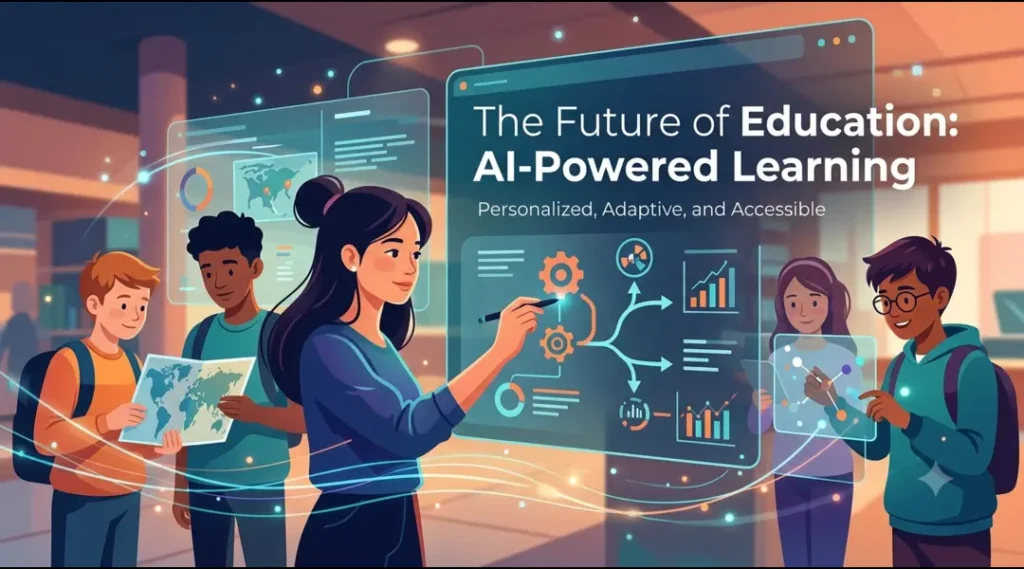
Education is changing faster than ever. Classrooms that once depended mainly on textbooks, lectures, and traditional assignments are increasingly using digital tools to make learning more personalized and accessible. At the center of this transformation is artificial intelligence.
AI powered learning is changing how students study, how teachers prepare lessons, and how educational institutions understand learning outcomes. Instead of offering exactly the same learning experience to everyone, AI can help create learning experiences that respond to individual needs, abilities, and progress.
This does not mean technology will replace teachers. Rather, the Future of Education is likely to involve a stronger partnership between educators and intelligent technology, where AI handles repetitive tasks while teachers focus more on guidance, creativity, motivation, and human connection.
For students, parents, teachers, and education professionals, understanding this shift is becoming increasingly important.
What Is AI Powered Learning?
AI powered learning refers to the use of artificial intelligence technologies to support teaching and learning. These systems can analyze information, recognize patterns, provide feedback, and adapt learning experiences based on a student’s needs.
For example, an AI learning platform may notice that a student is struggling with a particular mathematics concept. Instead of simply moving to the next lesson, the system may provide additional explanations, practice questions, examples, or learning resources.
AI can also support teachers by helping with tasks such as creating lesson materials, generating practice exercises, organizing information, and identifying areas where students may need additional support.
The goal is not to make education completely automated. The goal is to make learning more responsive, efficient, and useful.
How AI Is Changing the Future of Education
AI is already influencing several important parts of the educational experience. Its impact is likely to grow as schools and learners become more comfortable using responsible AI tools.
Personalized Learning Experiences
One of the biggest advantages of AI in education is personalization.
Traditional classrooms often require teachers to manage students with different learning speeds and levels of understanding at the same time. While experienced teachers can adapt their approach, there are practical limits to how much individual attention one person can provide.
AI can help bridge part of that gap.
An intelligent learning system can analyze a student’s performance and adjust the difficulty, pace, or type of practice accordingly. A student who understands a topic quickly may receive more advanced exercises, while someone who needs additional support can spend more time building foundational knowledge.
This approach can make learning feel less frustrating and more relevant to each student.
Smarter Feedback for Students
Feedback is essential for improvement, but students may sometimes wait hours or days before receiving it.
AI tools can provide immediate feedback on certain types of work. For example, a learning platform can identify errors in a practice activity and explain the concept behind the mistake.
This creates an opportunity for students to learn while the topic is still fresh.
However, AI feedback should not always be treated as automatically correct. Students and teachers still need to evaluate information critically, particularly when AI is used for complex subjects or open ended questions.
AI Assistants for Teachers
Teachers spend significant time on administrative and repetitive activities. AI can potentially reduce some of this workload.
Depending on the tool and educational setting, teachers may use AI to brainstorm lesson ideas, create practice questions, organize educational resources, or generate different explanations of a difficult concept.
This can give educators more time to focus on activities where human judgment matters most, such as mentoring students, understanding classroom dynamics, encouraging participation, and supporting individual development.
The teacher remains an important part of the learning process. AI works best as a support tool rather than a replacement for professional judgment.
More Accessible Education
Technology can also make education more accessible.
AI based tools can assist with language translation, speech recognition, text generation, summarization, and other forms of communication. These capabilities may help learners who face language barriers or require different ways of interacting with educational materials.
For students learning remotely, AI can also provide additional support outside normal classroom hours.
This could make education more flexible for learners who cannot always follow a traditional schedule.
The Benefits of AI in Education
The potential benefits of AI powered learning extend beyond convenience.
Better Learning Personalization
Students do not all learn in the same way or at the same pace. AI can help educational platforms respond to individual learning patterns rather than relying entirely on a single teaching path.
Faster Identification of Learning Gaps
AI can analyze patterns in student performance and highlight topics that may require additional attention. Teachers can then use this information to provide targeted support.
Increased Learning Flexibility
AI tools can potentially provide assistance at different times and locations. This is especially useful for independent learners, online students, and people balancing education with work or other responsibilities.
Support for Teachers
When repetitive tasks are reduced, educators may have more time for higher value activities such as mentoring, classroom interaction, and personalized support.
More Interactive Learning
AI can make learning more conversational and interactive. Students can ask questions, request explanations, explore examples, and practice concepts in ways that may feel more engaging than simply reading a textbook.
Challenges and Risks of AI Powered Learning
The Future of Education will not be successful simply because schools use more AI. Technology also creates important challenges that need careful attention.
Accuracy and Misinformation
AI systems can sometimes provide incorrect or misleading information. Students should learn to verify important information instead of accepting every AI generated answer as fact.
Teachers remain essential for helping students develop critical thinking and information evaluation skills.
Privacy and Data Protection
Educational technology may process information about students and their learning behavior. Schools and technology providers need to take privacy and security seriously.
Parents, students, teachers, and institutions should understand what information a tool collects, why it is collected, and how it is used.
Digital Inequality
Not every student has equal access to reliable devices, high speed internet, or advanced educational technology.
If AI becomes a major part of education without addressing access issues, existing inequalities could become worse.
Overdependence on Technology
AI should support learning rather than replace learning.
If students use AI to complete every assignment without understanding the underlying concepts, they may achieve short term convenience but lose opportunities to develop independent thinking, writing, problem solving, and research skills.
The best approach is to use AI as a learning assistant while keeping human effort and understanding at the center.
AI and the Skills Students Will Need
The growth of AI is also changing what students need to prepare for future careers.
Knowing how to use AI tools may become useful, but technology skills alone will not be enough. Students will also need communication, creativity, critical thinking, collaboration, adaptability, and problem solving.
These abilities can help people work effectively alongside increasingly capable technologies.
Students interested in preparing for a changing workplace can also explore Future Career Skills to understand the broader abilities that may become valuable as technology and industries evolve.
AI Literacy
Students should understand what AI can do, where it can make mistakes, and how to use it responsibly.
Critical Thinking
When AI can generate answers quickly, knowing how to question and evaluate those answers becomes even more important.
Creativity
Human creativity remains valuable because new ideas often require imagination, context, emotion, and original thinking.
Communication
The ability to explain ideas clearly and work with other people will continue to matter, regardless of how advanced technology becomes.
Adaptability
Technology changes quickly. Students who learn how to learn, adapt, and develop new skills may be better prepared for changing career requirements.
How Teachers Can Prepare for AI Powered Education
Teachers do not need to become AI engineers to participate in the changing education landscape.
A practical first step is understanding the tools students are already using. Educators can experiment with AI for lesson planning, brainstorming, practice activities, and personalized explanations while carefully reviewing the output.
Schools can also establish clear guidelines for responsible AI use.
Students should understand when AI assistance is appropriate, when original work is expected, and why verifying AI generated information matters. Teaching these principles can be more valuable than simply banning technology.
Professional development will also play an important role. As AI tools evolve, educators need opportunities to learn how they work, understand their limitations, and determine where they genuinely improve learning.
What Will the Future Classroom Look Like?
The classroom of the future may not look completely different from today’s classroom. Students may still read, write, discuss ideas, conduct experiments, work in groups, and learn from teachers.
The difference may be how technology supports those activities.
Imagine a classroom where an AI system helps identify which concepts individual students are struggling with. The teacher can then spend more time working directly with those students while others continue practicing independently.
Students may also have access to AI learning assistants that explain difficult concepts in different ways, generate practice questions, or help them explore topics beyond the standard curriculum.
This model combines technology with human teaching rather than choosing one over the other.
How Students Can Prepare Today
Students do not need to wait for the education system to completely change before preparing for an AI influenced future.
A few practical habits can make a difference:
Learn How AI Works
You do not need advanced programming knowledge to understand the basics of artificial intelligence, machine learning, and generative AI.
Use AI as a Tutor, Not a Shortcut
Ask AI to explain a concept, create practice questions, or provide feedback. Then try solving the problem independently.
Verify Important Information
Compare AI generated information with reliable educational sources, textbooks, academic resources, or guidance from qualified teachers.
Build Human Skills
Spend time developing communication, creativity, teamwork, critical thinking, and problem solving alongside technical skills.
Stay Curious
The most valuable skill in a rapidly changing environment may be the ability and willingness to keep learning.
The Human Side of the Future of Education
Technology can improve education, but education has always been about more than delivering information.
Teachers inspire students. Classmates create social connections. Mentors provide encouragement. Real world experiences help learners understand how knowledge applies beyond a classroom.
AI cannot replace all of these human elements.
The strongest model for the Future of Education is therefore likely to be human centered. AI can provide personalized support, faster feedback, and useful learning tools, while teachers continue to provide context, empathy, judgment, motivation, and meaningful relationships.
That balance will be important as educational institutions decide which technologies are genuinely useful and which simply add complexity.
Final Thoughts
AI powered learning has the potential to make education more personalized, flexible, accessible, and responsive. It can support students with individualized practice, help teachers manage repetitive work, and provide new ways to explore knowledge.
At the same time, responsible implementation matters. Accuracy, privacy, digital access, academic integrity, and overdependence on technology are real concerns that educators and institutions need to address.
The most promising approach is not to ask whether AI will replace traditional education. Instead, we should ask how AI can help people learn better while preserving the human qualities that make education meaningful.
The Future of Education will likely be shaped by collaboration between people and technology. Students who learn to use AI thoughtfully, verify information, think critically, and develop strong human skills can be better prepared for an evolving world.
Ultimately, the goal should remain simple: use technology to help people learn more effectively, not simply to make education more automated.