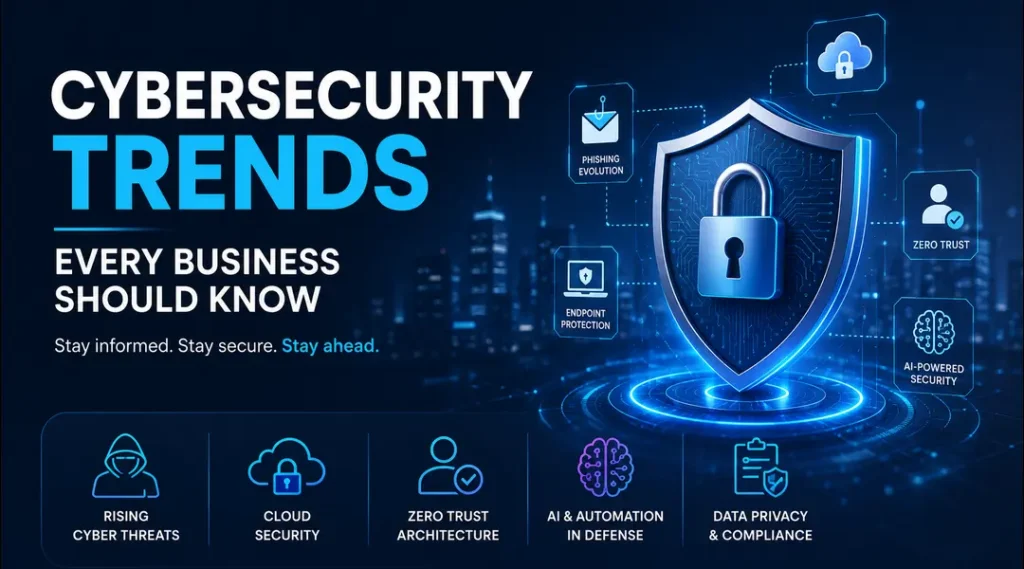
Cybersecurity is no longer just an IT concern. It has become a business priority that can affect customer trust, operational continuity, financial performance, and brand reputation. As companies rely more heavily on cloud platforms, artificial intelligence, remote work tools, connected devices, and digital services, the number of potential security risks continues to grow.
The cybersecurity landscape is also changing quickly. Attackers are using automation and artificial intelligence to make phishing, impersonation, fraud, and other attacks more convincing and scalable. At the same time, businesses are strengthening their defenses with better identity controls, zero trust security, security automation, and improved threat detection.
Understanding the latest Cybersecurity Trends can help business owners, managers, and technology teams make smarter security decisions. Instead of reacting only after an incident, organizations can prepare for emerging risks and build a stronger security strategy.
Here are the most important cybersecurity trends businesses should understand today.
Artificial Intelligence Is Changing Cybersecurity
Artificial intelligence is becoming one of the most important forces shaping cybersecurity. Security teams can use AI to analyze large amounts of security data, identify unusual behavior, detect suspicious activity, summarize alerts, and support incident response.
However, AI can also benefit cybercriminals. Attackers can use AI assisted tools to create more convincing phishing messages, automate reconnaissance, generate social engineering content, and personalize scams. Recent security research highlights AI powered social engineering, automated malware, deepfakes, and adversarial AI as important emerging risk areas.
This creates an important balance for businesses. AI should not simply be treated as another software feature. Organizations need clear rules for how employees use AI tools, what company information can be shared with them, and how AI generated content is reviewed.
What Businesses Should Do
Businesses should consider creating an AI security policy, reviewing third party AI tools, limiting sensitive data exposure, and monitoring how AI systems interact with company applications and information.
For organizations planning long term technology investments, understanding the Future of Artificial Intelligence is increasingly connected to understanding the future of cybersecurity.
Identity Security Is Becoming a Top Priority
Passwords alone are no longer enough to protect business accounts. Modern organizations have employees, contractors, customers, applications, cloud services, APIs, and increasingly automated systems that all require access.
This makes identity and access management a central part of modern cybersecurity.
Identity based attacks are especially concerning because stolen credentials can allow attackers to appear like legitimate users. Recent 2026 ransomware research reported that identity based approaches were involved in a large share of ransomware incidents, highlighting the importance of protecting accounts and access pathways.
Businesses should focus on strong authentication, least privilege access, account monitoring, and rapid removal of unnecessary permissions.
Practical Identity Protection Steps
Businesses can strengthen identity security by:
- Enabling multi factor authentication for important accounts
- Using phishing resistant authentication where practical
- Applying least privilege access
- Reviewing inactive and unnecessary accounts
- Monitoring unusual login activity
- Protecting administrator accounts separately
- Regularly reviewing employee and third party permissions
Identity security is not just about protecting usernames and passwords. It is about controlling who can access business resources, what they can access, and whether their activity appears legitimate.
Zero Trust Security Is Moving Into the Mainstream
Traditional security models often relied on the idea that users inside a company network could be trusted more than users outside it. Modern businesses operate differently. Employees work remotely, applications run in the cloud, contractors need access, and company data may be distributed across multiple platforms.
Zero trust security addresses this environment by treating access as something that should be continuously verified rather than automatically trusted. Its core principles include identity verification, least privilege, segmentation, and continuous monitoring.
Why Zero Trust Matters
A zero trust security strategy can reduce the potential impact of compromised accounts and limit unauthorized movement between systems.
Businesses do not necessarily need to replace their entire infrastructure overnight. A practical approach is to begin with high value applications and sensitive data, strengthen identity controls, introduce stronger authentication, and gradually expand zero trust practices.
Ransomware Continues to Be a Serious Business Risk
Ransomware remains one of the most damaging cybersecurity threats for organizations of all sizes. A successful attack can interrupt operations, expose sensitive information, create recovery costs, and damage customer confidence.
Modern ransomware attacks are also increasingly connected to identity compromise, phishing, vulnerable systems, and stolen credentials. Recent 2026 reporting shows that organizations continue to face substantial recovery costs following ransomware incidents.
The best ransomware strategy is not simply trying to prevent every attack. Businesses should also prepare for the possibility that an attacker gets inside.
Building Ransomware Resilience
A strong ransomware defense should include:
- Tested and protected backups
- Multi factor authentication
- Endpoint detection and response
- Timely security updates
- Network segmentation
- Employee security awareness training
- Incident response procedures
- Regular recovery testing
Backups are particularly important, but having backups is not enough. Businesses should regularly test whether critical systems and data can actually be restored.
Phishing and Social Engineering Are Becoming More Convincing
Employees remain an important part of an organization’s security defenses because attackers frequently target human trust.
Phishing emails are becoming more polished, personalized, and difficult to identify. AI can help attackers create convincing messages without the obvious spelling mistakes and awkward language that once made many scams easier to recognize.
Social engineering can also happen through text messages, phone calls, social platforms, collaboration tools, and fake business communications. AI generated impersonation and deepfake technology can make executive fraud and identity scams more difficult to recognize.
Security Awareness Should Be Continuous
Annual security training alone may not be enough. Businesses should provide regular, practical security education covering phishing, password safety, suspicious links, social engineering, AI generated scams, and reporting procedures.
Employees should also know exactly what to do when they suspect an attack. A fast internal report can help security teams respond before a small mistake becomes a larger incident.
Cloud Security Needs More Attention
Cloud services have transformed how companies store data and run applications. They can improve flexibility and scalability, but cloud environments also introduce security responsibilities that businesses must actively manage.
Misconfigured storage, excessive permissions, exposed credentials, insecure APIs, and poorly managed third party integrations can create significant risks.
Cloud security should therefore be part of the overall cybersecurity strategy rather than treated as a separate technical issue.
Important Cloud Security Practices
Businesses should regularly review cloud permissions, protect administrative accounts, encrypt sensitive information, monitor cloud activity, secure APIs, and maintain clear visibility into the services employees are using.
Organizations should also understand their responsibilities under the shared responsibility model used by many cloud providers. A cloud provider may secure parts of the underlying infrastructure, but customers remain responsible for many aspects of their own accounts, configurations, applications, and data.
Supply Chain Security Is Becoming More Important
Businesses rarely operate completely on their own. They depend on software vendors, cloud providers, payment processors, contractors, managed service providers, and other technology partners.
This creates supply chain risk. A security problem at a trusted third party can potentially affect many customers.
Businesses should therefore evaluate the security practices of important vendors before giving them access to sensitive systems or information.
What Vendor Security Reviews Should Cover
A vendor risk assessment can consider:
- What data the vendor can access
- Which systems the vendor can connect to
- How the vendor protects customer information
- Whether strong authentication is required
- How security incidents are reported
- How access is removed when a contract ends
- Whether the vendor has appropriate security certifications or independent assessments
Third party risk management becomes especially important as businesses continue to adopt SaaS platforms and interconnected digital services.
Vulnerability Management Is Becoming a Race Against Time
Security vulnerabilities can create opportunities for attackers when organizations delay patches or fail to identify exposed systems.
Recent cybersecurity reporting indicates that attackers are becoming faster at exploiting newly disclosed vulnerabilities, increasing pressure on organizations to identify and remediate critical weaknesses quickly.
Businesses should maintain an accurate inventory of devices, applications, cloud resources, and internet exposed systems. Without knowing what technology exists, it is difficult to determine what needs to be protected.
A Better Vulnerability Management Process
Instead of treating every vulnerability equally, businesses should prioritize based on factors such as severity, exploitability, internet exposure, business importance, and whether sensitive information is involved.
Critical vulnerabilities affecting public facing systems should receive particularly fast attention.
How Businesses Can Prepare for These Cybersecurity Trends
Businesses do not need to adopt every new security product immediately. A better strategy is to focus on fundamentals first and then build from there.
Start by identifying your most valuable data, systems, applications, and business processes. Next, determine who has access to them and where the biggest security gaps exist.
A practical cybersecurity roadmap can include:
- Enable strong authentication across important accounts.
- Create and test reliable backups.
- Keep operating systems and applications updated.
- Train employees regularly on phishing and social engineering.
- Review cloud and third party access.
- Monitor important systems for unusual activity.
- Create an incident response plan.
- Test recovery procedures regularly.
- Establish clear rules for business AI usage.
- Review the security strategy at least periodically as threats evolve.
The goal is not to create a perfect security environment. No organization can eliminate every cyber risk. The goal is to make attacks harder to execute, detect suspicious activity earlier, limit damage, and recover quickly.
Final Thoughts
The cybersecurity environment is changing alongside the way businesses use technology. Artificial intelligence, identity based attacks, zero trust security, ransomware, cloud environments, supply chain risks, phishing, vulnerability exploitation, and security automation are all influencing how organizations should approach digital protection.
The most effective security strategy is not based on following every technology trend. It is based on understanding business risks and building strong fundamentals around people, processes, technology, and data.
Businesses that regularly review their security controls, educate employees, protect identities, secure cloud environments, maintain tested backups, and prepare for incidents will be better positioned to handle an evolving threat landscape.
Cybersecurity should be treated as an ongoing business responsibility rather than a one time technology project. As new tools and threats emerge, organizations that continuously improve their security practices can protect their operations while building greater trust with customers and partners.