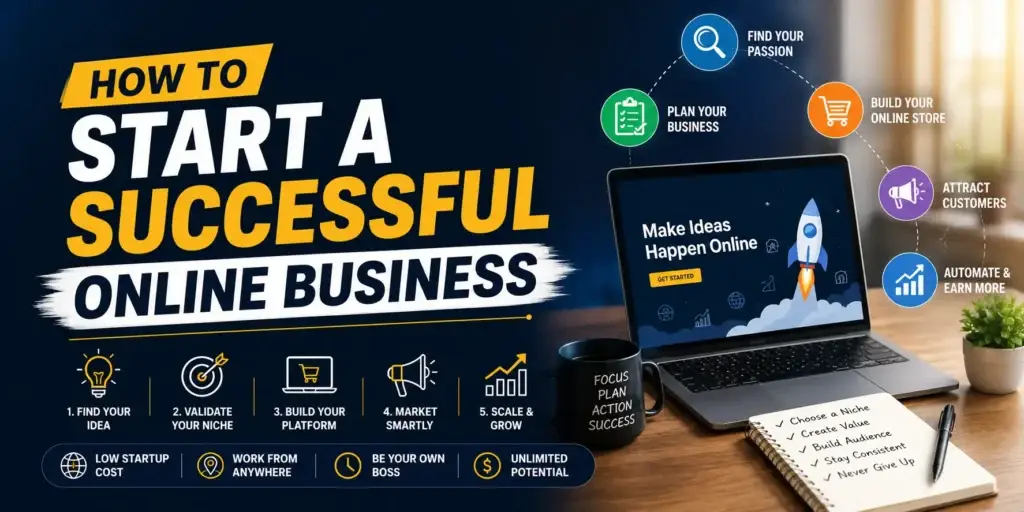
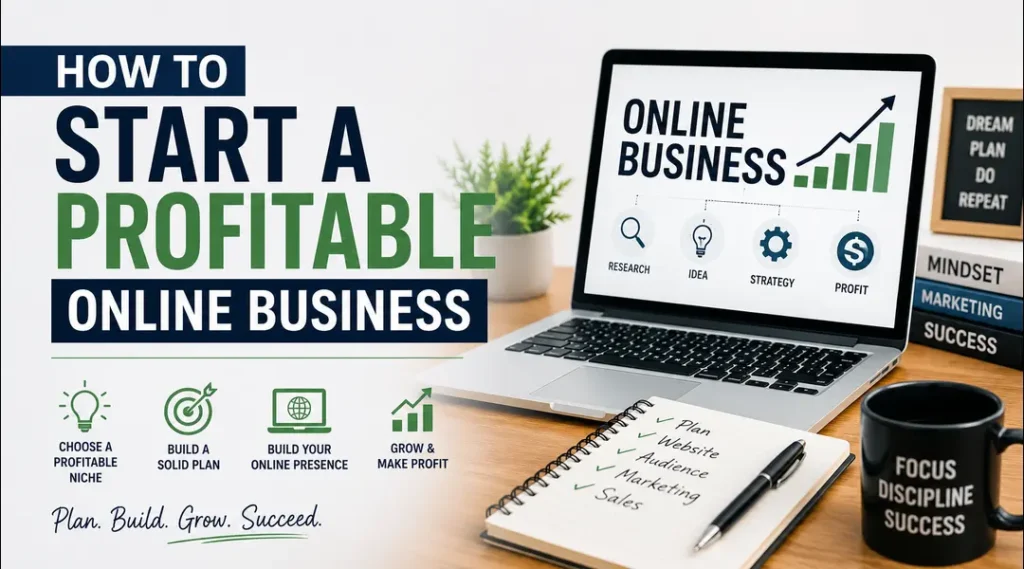
Starting an online business can look easier than it really is. You can create a website, open a social media account, or launch a digital product in a few hours. But building a Profitable Online Business requires more than simply being online.
You need a useful offer, a clear audience, a realistic business model, consistent marketing, and a way to turn visitors into paying customers.
The good news is that you do not need a huge budget or a large team to get started. Many online businesses begin with one person solving one specific problem for one specific group of customers.
In this guide, you will learn how to choose an online business idea, validate demand, create an offer, attract customers, and build a sustainable income stream.
What Is a Profitable Online Business?
A profitable online business is a digital business that generates more revenue than its operating costs over time.
It can take many forms, including:
Digital products
You can sell ebooks, templates, online courses, checklists, guides, spreadsheets, or other downloadable resources.
Freelance services
If you have skills in writing, graphic design, web development, SEO, video editing, consulting, or virtual assistance, you can sell those skills directly to clients.
Affiliate marketing
Affiliate marketing allows you to recommend relevant products or services and earn a commission when someone makes a qualifying purchase through your referral.
Ecommerce
An ecommerce business sells physical or digital products through an online store. You can create your own products, source products, or use a suitable fulfillment model.
Content based businesses
Blogs, YouTube channels, newsletters, podcasts, and niche websites can generate revenue through advertising, sponsorships, affiliate partnerships, memberships, or products.
The best model depends on your skills, available time, budget, and the needs of your target audience.
Choose a Business Idea That Solves a Real Problem
One of the biggest mistakes beginners make is choosing an idea simply because it sounds profitable.
Instead, start with a problem.
Ask yourself:
- What problem can I solve?
- Who experiences this problem?
- How frequently does the problem occur?
- Are people already paying for solutions?
- Can I provide a better, simpler, faster, or more convenient solution?
For example, instead of starting a general marketing service, you could focus on helping local service businesses improve their Google Business Profile content and website visibility.
A specific audience makes your marketing easier because you understand exactly who you are speaking to.
Research your target audience
Spend time understanding your potential customers before investing heavily.
Look at questions people ask in communities, search results, social media discussions, product reviews, and industry forums. Pay attention to repeated complaints and unanswered questions.
This research can help you discover profitable niche ideas and create content that addresses genuine customer needs.
Validate Your Idea Before Spending Too Much
You do not need to build a complete business before discovering whether people want your offer.
Start small.
Create a basic version of your service or product and test it with real potential customers. If you are offering a service, try getting your first few clients before building a complicated website.
If you want to sell a digital product, consider creating a small version first. For example, instead of spending months developing a large course, you could start with a focused guide or workshop.
The goal is to collect evidence.
Positive signals can include:
- People asking for more information
- Potential customers joining your email list
- People booking consultations
- Customers making purchases
- Existing customers recommending your service
Validation reduces the risk of spending significant time and money on an idea that has little demand.
Create a Simple Business Plan
You do not need a fifty page business plan to start.
A simple one page plan can be enough initially.
Write down:
Target customer
Describe the specific person or business you want to serve.
Problem
Explain the problem they want to solve.
Solution
Describe what you will provide and why it is useful.
Revenue model
Decide whether you will make money through services, products, subscriptions, affiliate commissions, advertising, or another method.
Customer acquisition
Choose the channels you will use to reach customers, such as search engines, social media, email marketing, partnerships, or paid advertising.
Main expenses
List important costs such as website hosting, software, payment processing, marketing, equipment, and professional services.
This simple plan gives you a practical direction without making the process unnecessarily complicated.
Build Your Online Presence
Once your idea is validated, create a professional online presence.
At minimum, consider having a website with:
- A clear homepage
- About page
- Contact page
- Privacy Policy
- Terms or relevant legal information
- Clear product or service pages
- Helpful educational content
Your website should be easy to navigate on both desktop and mobile devices.
Google’s AdSense guidance emphasizes unique content, clear navigation, relevant information, and a good user experience.
For a content website, avoid publishing dozens of shallow articles simply to target keywords. Instead, create useful resources that answer real questions and provide meaningful information.
Use SEO to Attract the Right Visitors
Search engine optimization can become a powerful source of long term traffic for an online business.
Start with keyword research based on search intent.
For example, someone searching for “how to start an online business” may be looking for educational information, while someone searching for “online bookkeeping service for small business” may have a stronger commercial intention.
Your SEO strategy can include:
Informational keywords
These help you attract people researching a topic.
Examples include:
- how to start an online business
- best online business ideas
- how to sell digital products
- online business ideas for beginners
Commercial keywords
These target people comparing solutions.
Examples include:
- best email marketing tools
- best website builders for small business
- best AI tools for entrepreneurs
- online business software
Transactional keywords
These target people who are closer to making a purchase.
Examples include:
- buy business templates
- hire freelance SEO consultant
- online accounting service for small business
Use keywords naturally. Do not repeat the same phrase excessively. Google’s people first guidance focuses on creating genuinely helpful content rather than content created primarily to manipulate search rankings.
Use AI Carefully and Add Human Value
AI tools can help entrepreneurs brainstorm ideas, organize research, create outlines, analyze data, and improve productivity.
However, simply generating large amounts of generic content is not a reliable business strategy.
If you use AI while building content or products, add human judgment and genuine value.
For example, you can:
- Verify important facts
- Add your own observations
- Include practical examples
- Explain what worked and what did not
- Update outdated information
- Add original research or analysis
- Make the content easier for real people to understand
If you are exploring automation and productivity, our guide to Best AI Tools for Entrepreneurs can also help you identify practical ways to streamline repetitive business tasks.
Get Your First Customers
Your first customers are often more important than your first large traffic spike.
Start with channels where your potential customers already spend time.
You can:
- Contact relevant prospects directly
- Publish helpful social media content
- Build an email list
- Answer questions in relevant communities
- Publish SEO focused articles
- Partner with complementary businesses
- Offer a useful introductory service
- Ask satisfied customers for referrals
Do not try every marketing channel at once.
Choose one or two channels and become consistent.
For example, if you are good at writing, SEO content and email marketing may be a better starting point than spending money on video advertising.
Track Revenue, Costs, and Profit
Revenue alone does not mean your business is profitable.
Suppose your business generates $5,000 in monthly revenue but costs $4,500 to operate. Your profit before applicable taxes and other considerations is only $500.
Track important numbers such as:
- Monthly revenue
- Operating expenses
- Customer acquisition cost
- Average order value
- Conversion rate
- Repeat customer rate
- Profit margin
These numbers help you understand which parts of your business deserve more attention.
You may discover that increasing prices, improving conversion rates, reducing unnecessary software expenses, or retaining existing customers can have a greater impact than simply chasing more website traffic.
Scale What Already Works
Do not rush to scale before you have a repeatable process.
First, identify what is already working.
Maybe one blog post consistently brings qualified visitors. Maybe one service generates most of your revenue. Perhaps one marketing channel produces better customers than all the others.
Double down on proven results.
You can then improve your business through:
Automation
Automate repetitive tasks such as appointment reminders, email sequences, invoicing, reporting, and customer onboarding where appropriate.
Better systems
Document recurring processes so you can perform them consistently and eventually delegate them.
Stronger offers
Improve your product or service based on customer feedback.
Content expansion
Turn successful topics into related articles, videos, guides, newsletters, or downloadable resources.
The objective is not to make your business complicated. It is to create systems that allow you to deliver more value without unnecessarily increasing your workload.
Common Mistakes to Avoid
Building an online business becomes easier when you know which mistakes to avoid.
Chasing every trend
A trending business idea is not automatically a good fit for you or your audience.
Targeting everyone
A narrow audience usually makes it easier to create relevant messaging and useful products.
Spending too much before validation
Avoid investing heavily in branding, software, inventory, or advertising before you know whether customers want your offer.
Publishing low value content
More articles do not automatically mean better SEO. Focus on originality, usefulness, accuracy, and a satisfying reader experience.
Expecting instant results
A sustainable online business usually requires experimentation and consistent improvement.
Is Starting an Online Business Still Worth It?
Yes, but it is important to have realistic expectations.
An online business can provide flexibility, access to a global audience, and opportunities to build multiple revenue streams. At the same time, competition is significant, and success is rarely instant.
The strongest approach is to think like a problem solver rather than someone searching for a quick income opportunity.
Find a specific audience. Understand its needs. Create something genuinely useful. Make it easy to buy. Deliver a good customer experience. Then improve the business based on real feedback.
Final Thoughts
Starting a Profitable Online Business does not require a perfect idea or a massive investment.
You can begin with a simple offer, validate it with real people, build a trustworthy online presence, and gradually improve your marketing and operations.
Focus on solving a real problem instead of chasing quick money. Create original and useful content instead of publishing for search engines alone. Use AI as a productivity assistant while adding your own judgment, experience, and verification.
Most importantly, build trust.
A sustainable online business is not created by one viral post or one clever tactic. It is built by consistently providing value to the right people and creating a business model that works financially.