Running a business means making decisions, solving problems, communicating with customers, creating content, managing finances, and finding new ways to grow. For many entrepreneurs, the biggest challenge is not a lack of ideas. It is a lack of time.
This is where artificial intelligence can make a real difference.
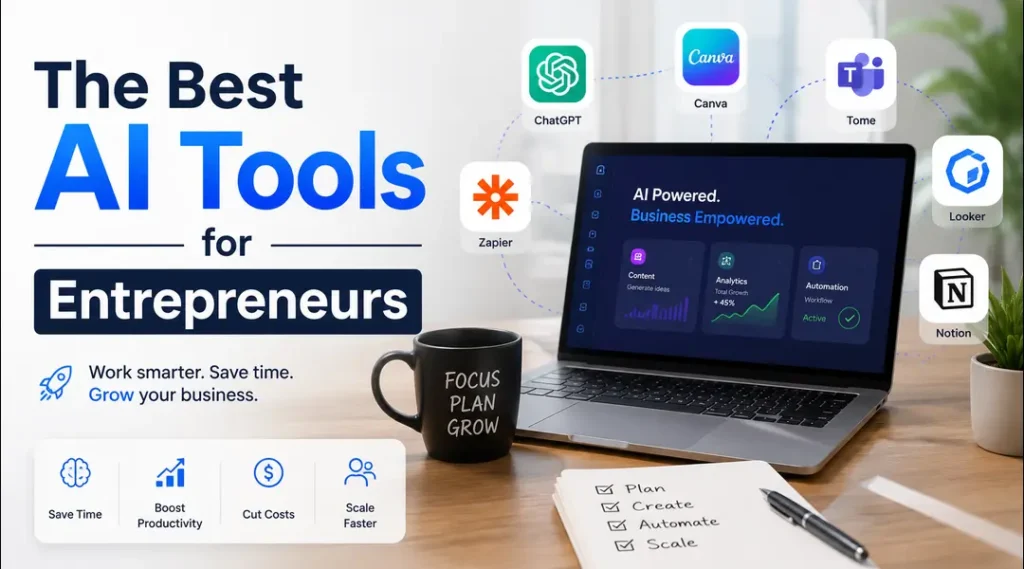
The Best AI Tools for Entrepreneurs can help reduce repetitive work, speed up research, improve content, organize information, automate workflows, and support better decision making. The goal is not to replace your judgment or creativity. Instead, the right AI tools can give you more time to focus on the work that actually moves your business forward.
In this guide, we will explore practical AI business tools for writing, research, productivity, design, automation, and business growth. We will also explain how to choose the right tools without filling your business with unnecessary subscriptions.
Why Entrepreneurs Should Use AI Tools
Entrepreneurs often have to work across several areas at once. One day you may be writing a marketing email, and the next you may be analyzing customer feedback, researching competitors, creating social media content, or planning your next product launch.
AI can help with many of these tasks.
For example, ChatGPT can help entrepreneurs draft and refine business communication, organize ideas, summarize information, and analyze uploaded data. OpenAI also documents its use for workplace writing and data analysis.
The biggest benefits include:
- Saving time on repetitive work
- Generating and organizing ideas faster
- Improving business communication
- Supporting market and competitor research
- Creating marketing content more efficiently
- Automating repetitive workflows
- Turning business data into useful insights
However, AI should be treated as an assistant rather than an unquestionable source of truth. Entrepreneurs should review important information, verify facts, and use human judgment before making financial, legal, hiring, or strategic decisions.
Best AI Tools for Entrepreneurs
There is no single AI tool that is perfect for every entrepreneur. The best choice depends on what you are trying to accomplish.
Here are some of the most useful categories and tools to consider.
1. ChatGPT for Business Writing and Everyday Tasks
ChatGPT is one of the most flexible AI productivity tools for entrepreneurs.
You can use it to brainstorm business ideas, write emails, create outlines, summarize documents, develop content ideas, prepare meeting notes, analyze data, and organize business information.
It can also help transform rough thoughts into professional communication. OpenAI describes ChatGPT as useful for drafting, rewriting, tightening, and adapting workplace writing for different audiences.
Best uses for entrepreneurs
- Business brainstorming
- Email writing
- Blog outlines
- Social media ideas
- Customer response drafts
- Business data analysis
- Meeting summaries
- Standard operating procedure drafts
For example, instead of spending an hour trying to organize a rough idea, you can give AI your notes and ask it to create a clear structure. You can then edit the result using your own knowledge and experience.
This makes ChatGPT a strong option for entrepreneurs who want one general purpose AI assistant.
2. Claude for Long Form Writing and Analysis
Claude is another useful AI assistant for entrepreneurs who regularly work with long documents, detailed research, and written content.
It can be useful when you need help reviewing large amounts of information, developing detailed drafts, comparing ideas, or improving the clarity of business documents.
For content teams, it can also assist with creating article outlines, refining existing copy, and developing brand messaging.
The important thing is to give the AI clear context. Instead of asking it to simply “write something about my business,” provide your audience, business goal, tone, product information, and key points.
Better instructions usually lead to more useful results.
3. Google Gemini for Google Workspace Users
For entrepreneurs who already rely heavily on Google’s ecosystem, Gemini can be a practical AI business tool.
It can be especially useful when your everyday workflow revolves around services such as Gmail, Docs, and other Google Workspace products.
This makes it useful for entrepreneurs who want AI assistance within an existing productivity environment rather than constantly moving information between different platforms.
Good uses include
- Drafting business communication
- Summarizing information
- Brainstorming
- Research support
- Working with documents
- Organizing ideas
The best AI tool is often the one that fits naturally into the systems you already use.
4. Perplexity for Business Research
Research is a major part of entrepreneurship.
Before launching a product, creating content, entering a new market, or evaluating competitors, you need reliable information. AI research tools can make the first stage of that process much faster.
Perplexity is particularly useful for research focused tasks because it combines AI generated answers with web sources.
Entrepreneurs can use research tools to explore:
- Industry trends
- Competitor positioning
- Customer questions
- Market opportunities
- Product comparisons
- Emerging technologies
- Content research
Still, do not blindly accept an AI generated answer. Open the cited sources and verify important claims before using them in business decisions or published content.
5. Canva for AI Content Creation
Visual content is essential for modern businesses. Entrepreneurs need social media graphics, presentations, promotional materials, thumbnails, simple advertisements, and other branded assets.
Canva can help entrepreneurs create these materials without requiring advanced graphic design skills.
AI powered design features can speed up the process of turning an idea into a visual asset. This can be particularly helpful for solo founders and small teams that need to produce content regularly.
Canva can help with
- Social media graphics
- Presentations
- Marketing visuals
- Blog graphics
- Promotional materials
- Brand content
- Simple video content
AI can make the first version faster, but your brand style still matters. Always review typography, images, messaging, and facts before publishing.
6. Notion for AI Productivity and Organization
Entrepreneurs have a lot of information to manage.
Ideas, project plans, meeting notes, customer research, content calendars, processes, and business documentation can quickly become difficult to organize.
Notion can serve as a central workspace for managing this information, while its AI capabilities can help with tasks such as summarizing and organizing content.
This makes it useful for entrepreneurs who want to bring business knowledge and productivity into one organized environment.
A well structured workspace can be especially valuable as a company grows and more people become involved.
7. Zapier for AI Workflow Automation
Automation becomes increasingly important when a business starts growing.
Zapier connects different applications and can automate actions between them. Its current platform supports AI powered automation and integrations across thousands of applications.
For example, an entrepreneur could create a workflow where a new lead triggers a series of actions involving a CRM, email platform, spreadsheet, or AI service.
Examples of AI automation
- Organizing new leads
- Sending follow up messages
- Summarizing customer feedback
- Categorizing incoming information
- Creating internal notifications
- Moving data between applications
- Automating repetitive administrative tasks
The real advantage is not simply using AI. It is connecting AI to a repeatable business process.
8. AI Tools for Customer Support
Customer service is another area where entrepreneurs can use AI.
AI customer service tools can help answer common questions, organize support requests, create response drafts, and provide customers with information outside normal working hours.
This can be valuable for small businesses that cannot maintain a large support team.
However, automation should not make customer service feel robotic. Give customers a clear path to a human when the issue is complicated, sensitive, or requires personal attention.
Good customer service is still about understanding people, not simply answering messages quickly.
How to Choose the Right AI Tools for Your Business
With thousands of AI products available, choosing tools can become confusing.
Instead of asking, “What are the most popular AI tools?” start by asking, “What is slowing my business down?”
Make a list of repetitive tasks that consume your time every week.
For example:
- Writing social media posts
- Responding to repetitive emails
- Preparing reports
- Researching competitors
- Creating marketing designs
- Organizing customer information
- Moving data between applications
Then look for an AI tool that solves a specific problem.
Consider ease of use
A powerful tool is not useful if you and your team never use it.
Choose software that fits your existing workflow and does not create unnecessary complexity.
Consider accuracy
AI can produce incorrect or incomplete information. For important business decisions, verify the output using reliable sources and your own expertise.
Consider privacy
Before uploading customer data, financial information, confidential documents, or proprietary business information, understand how the tool handles your data and what privacy controls are available.
Consider total cost
Do not subscribe to ten different AI tools simply because they are popular.
Start with one or two tools that solve your biggest problems. Measure the time saved and business value before adding more.
How Entrepreneurs Can Use AI Without Losing the Human Touch
AI works best when humans remain involved.
A common mistake is publishing AI generated content without reviewing it. That can result in generic writing, inaccurate information, repetitive ideas, or content that does not sound like your brand.
Instead, use AI for the first stage and bring your own expertise into the final result.
For example, you can ask AI to:
- Generate ideas
- Organize research
- Create a first draft
- Identify missing points
- Suggest improvements
- Summarize information
Then add your own experience, examples, opinions, original insights, customer knowledge, and final editorial judgment.
This approach creates content that is both efficient and useful.
If you are also working on broader Business Growth Tips for Entrepreneurs, AI can support the process by helping you research opportunities, analyze ideas, create content, and improve your operational efficiency.
A Simple AI Stack for a Small Business
You do not need a complicated technology stack to start.
A simple setup could include:
For writing and brainstorming
Use ChatGPT or Claude for ideas, drafts, research organization, communication, and analysis.
For research
Use an AI research assistant such as Perplexity, while verifying important claims through original sources.
For design
Use Canva for social media graphics, presentations, promotional content, and other visual assets.
For organization
Use Notion or a similar workspace to keep projects, documentation, and ideas organized.
For automation
Use Zapier when you have repetitive tasks that require information to move between different applications.
This type of focused AI stack is usually more practical than subscribing to every new AI application that appears.
Best Practices for Using AI in Business
The most successful entrepreneurs do not simply use AI more. They use it more intentionally.
Follow these practical guidelines:
- Start with a clear business problem.
- Use AI to save time rather than create unnecessary work.
- Give AI detailed context and clear instructions.
- Review important outputs before using them.
- Verify statistics, research, and factual claims.
- Protect confidential customer and business information.
- Keep your brand voice consistent.
- Measure whether an AI tool actually saves time or improves results.
- Remove tools that do not provide meaningful value.
- Keep human judgment involved in important decisions.
AI should improve your business process, not become another task you have to manage.
Final Thoughts
The best AI tools for entrepreneurs are not necessarily the tools with the longest feature lists. They are the tools that solve real problems and make your work easier.
ChatGPT and Claude can support writing and analysis. Gemini can be useful for entrepreneurs working within Google’s ecosystem. Perplexity can accelerate research. Canva can simplify visual content creation. Notion can help organize business knowledge, while Zapier can connect applications and automate repetitive workflows.
The right combination depends on your business, team, budget, and goals.
Start small. Choose one important problem, test one tool, measure the results, and expand your AI workflow only when there is a clear benefit.
Used thoughtfully, AI can give entrepreneurs something extremely valuable: more time to focus on customers, strategy, creativity, and sustainable business growth.
AI is not a replacement for entrepreneurial experience. It is a tool that can help you put that experience to work more efficiently.