
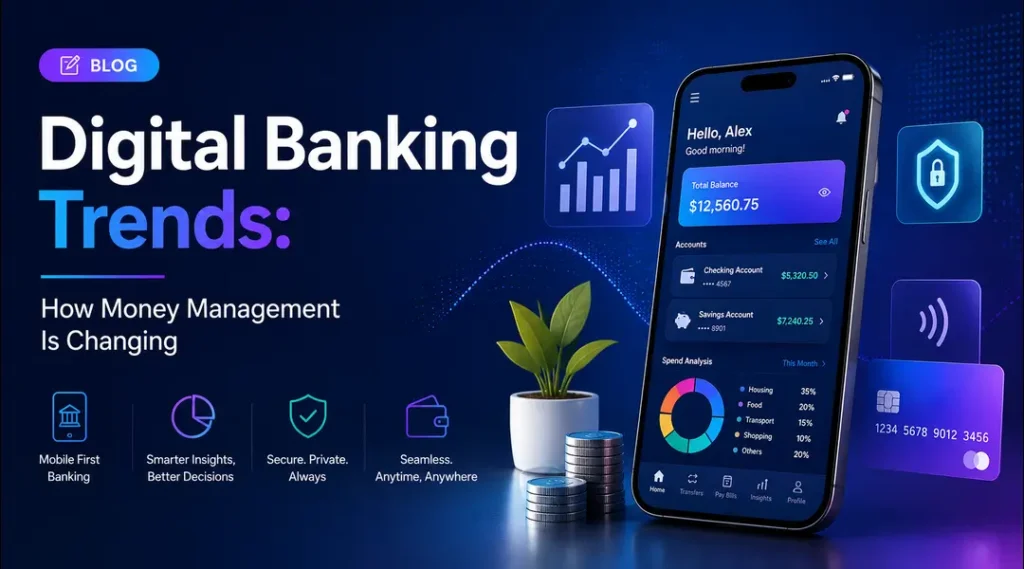
Managing money no longer means visiting a bank branch, waiting for statements, or keeping track of every transaction manually. Today, people can check balances, transfer money, pay bills, save, invest, and monitor spending from a smartphone.
This shift is being driven by rapid changes in financial technology and changing customer expectations. As banking becomes more digital, financial services are becoming more convenient, personalized, and accessible.
The latest Digital Banking Trends show that technology is not simply changing how people interact with banks. It is also changing how they understand, organize, and manage their money.
From artificial intelligence and mobile banking to open banking, digital payments, and stronger security, these developments are creating a new approach to personal finance.
What Are Digital Banking Trends?
Digital banking trends are the major technology and consumer behavior changes influencing how banking services are delivered and used.
Traditional banking focused heavily on physical branches and face to face interactions. Digital banking has expanded that experience through websites, mobile applications, automated services, digital payments, and connected financial tools.
The goal is not only to make banking faster. Modern digital banking is increasingly focused on giving customers better information and more control over their financial decisions.
Some important trends include:
Mobile First Banking
Smartphones have become one of the main ways customers interact with financial institutions. Mobile banking apps allow users to check account activity, transfer funds, deposit checks where supported, pay bills, and manage cards without visiting a branch.
This convenience is particularly valuable for people who want to manage everyday finances while traveling, working, or handling a busy schedule.
Artificial Intelligence in Banking
Artificial intelligence is becoming an important part of financial technology. Banks and financial platforms can use AI based systems to analyze information, automate certain processes, detect unusual activity, and provide more personalized experiences.
For consumers, this can mean smarter spending insights, automated financial notifications, and faster customer support.
Businesses are also exploring how AI can improve financial services. If you want to understand the broader impact, AI Is Transforming the Financial Industry in areas ranging from customer service to risk management and financial analysis.
Real Time Digital Payments
Digital payments have changed expectations around the speed and convenience of financial transactions.
Depending on the country and payment network, consumers may have access to instant or near instant transfers, digital wallets, contactless payments, and mobile payment services.
The growth of digital payments means people increasingly expect financial transactions to be simple, secure, and available when they need them.
How Digital Banking Is Changing Money Management
The biggest impact of these developments may be the way people manage their finances.
Banking is moving from an activity that happens occasionally to something people can monitor throughout the day.
Easier Expense Tracking
Digital banking applications can provide a clear view of account activity. Many platforms also organize transactions into categories, making it easier to identify recurring expenses and spending patterns.
Instead of waiting until the end of the month to review a bank statement, consumers can check their financial activity regularly.
This can encourage better financial awareness.
For example, someone may notice that several small purchases are adding up to a significant monthly expense. Seeing this information clearly can make it easier to adjust spending habits.
More Personalized Financial Insights
Another important trend is personalization.
Digital financial platforms can use account information and user activity to provide relevant notifications and insights. These may include reminders about upcoming payments, spending summaries, savings progress, or unusual transactions.
Personalization can make financial information easier to understand because users see information that is relevant to their individual situation.
However, consumers should always understand how their financial information is collected, processed, and protected before using any financial application.
Automated Savings
Saving money can be difficult when it depends entirely on remembering to transfer money manually.
Digital banking services increasingly provide automated savings features. Depending on the provider, users may be able to schedule recurring transfers or create specific savings goals.
Automation does not guarantee financial success, but it can make consistent saving easier.
A simple example is setting up an automatic transfer after receiving regular income. Over time, small contributions can help build an emergency fund or support another financial goal.
Better Financial Visibility
One of the most useful advantages of digital banking is having financial information available in one place.
Some modern financial tools allow users to view multiple accounts, monitor spending, or track financial goals through a single interface.
Better visibility can support better decision making because consumers have a clearer picture of their income, expenses, savings, and financial commitments.
The Growth of Open Banking
Open banking is another important development in the financial technology sector.
Open banking allows financial information to be shared between authorized financial service providers through secure technologies and permissions, subject to applicable regulations and consumer consent.
This can encourage competition and allow financial technology companies to develop services that work with information from different financial accounts.
For consumers, open banking may create more choices in budgeting, financial planning, payments, and account management.
However, convenience should not come at the expense of privacy. Users should pay attention to which companies have access to their financial information and what permissions they are granting.
Digital Banking and Financial Security
As more financial activity moves online, cybersecurity has become an essential part of modern money management.
Digital banking providers use various security measures to help protect accounts and transactions. These may include multi factor authentication, encryption, transaction monitoring, device verification, and fraud detection systems.
Consumers also have an important role to play.
Use Strong Account Security
Use unique passwords for financial accounts and enable multi factor authentication when available.
Avoid sharing passwords, verification codes, or security information with other people.
Be Careful With Financial Messages
Scammers may use emails, text messages, phone calls, or fake websites to imitate banks and financial services.
A message asking for urgent payment information or login credentials should be treated carefully.
When in doubt, contact the financial institution through an official website, application, or phone number rather than using a link or contact detail provided in a suspicious message.
Monitor Account Activity
Regularly reviewing transactions can help consumers identify unfamiliar activity sooner.
Account alerts can also be useful for monitoring payments, transfers, or other important account events.
Digital convenience works best when it is combined with responsible security habits.
The Role of Financial Technology in Personal Finance
Financial technology, often called fintech, is changing the relationship between consumers and financial services.
Fintech companies can provide tools for payments, budgeting, investing, lending, financial education, and other services.
This creates more choices for consumers, but more choices also require more careful evaluation.
Before using a financial application or service, consider factors such as:
Security and Privacy
Understand how the service protects personal and financial information. Review its privacy information and account security options.
Fees
Check whether the service charges subscription fees, transaction fees, withdrawal fees, foreign exchange charges, or other costs.
Regulation and Consumer Protection
Financial products and services can be subject to different rules depending on the provider, product, and location. Consumers should verify the provider and understand what protections may apply.
Transparency
A trustworthy financial service should clearly explain important terms, costs, limitations, and conditions.
What Is Next for Digital Banking?
The future of banking will likely involve even deeper integration between financial services and everyday technology.
Artificial intelligence may continue improving financial insights and customer support. Digital identity systems may make authentication more convenient. Real time payments may continue expanding in markets where the supporting infrastructure is available.
At the same time, consumers are likely to expect financial applications to be easier to use and more personalized.
The most important development may not be a single technology. Instead, it may be the combination of several technologies working together.
For example, a banking application could combine transaction data, automated insights, secure authentication, budgeting tools, and personalized notifications into one experience.
This could make money management more proactive rather than reactive.
Benefits and Challenges of Digital Banking
Digital banking offers several clear benefits, but it also comes with challenges.
Key Benefits
Convenience is one of the biggest advantages. Customers can access many banking services without visiting a physical branch.
Speed is another benefit. Digital transfers and payments can be significantly faster than some traditional processes.
Accessibility can also improve because customers can access services remotely, subject to internet availability and provider requirements.
Personalization may help users better understand their financial behavior through customized information and alerts.
Key Challenges
Security remains an ongoing concern as financial accounts become increasingly connected to digital devices.
Privacy is another consideration because financial applications may process significant amounts of personal information.
Technology access can also be a challenge. People who have limited access to smartphones, reliable internet, or digital services may not benefit equally from digital banking.
Finally, convenience can sometimes encourage people to make financial decisions too quickly. Easy access to payments and credit does not automatically mean a financial decision is a good one.
Consumers should continue to consider their budget, financial goals, and ability to manage financial commitments.
How Consumers Can Adapt to Digital Banking
Keeping up with banking technology does not require using every new financial application.
A better approach is to choose digital tools that solve genuine financial needs.
Start by reviewing your existing bank application and understanding the security and budgeting features it offers.
Next, enable useful account notifications and regularly review transactions.
If you use third party financial applications, check their privacy practices and permissions before connecting your accounts.
Finally, continue developing basic financial skills. Digital tools can make information easier to access, but they cannot replace good financial judgment.
Final Thoughts
The future of money management is becoming increasingly digital.
The latest Digital Banking Trends show that banking is moving beyond basic online account access toward more connected, personalized, and automated financial experiences.
Mobile banking, digital payments, artificial intelligence, open banking, automated savings, and improved security can all make financial management more convenient.
However, technology is only a tool. Consumers still need to protect their information, understand financial products, compare costs, and make decisions based on their individual circumstances.
The strongest digital banking experience is not simply the one with the most features. It is the one that helps people understand their money, manage it responsibly, and make informed financial decisions with confidence.
Frequently Asked Questions
What are the most important Digital Banking Trends?
Important trends include mobile first banking, artificial intelligence, digital payments, open banking, automated savings, personalized financial insights, and stronger digital security.
Is digital banking safe?
Digital banking can provide strong security features, but no digital system should be treated as completely risk free. Consumers should use strong passwords, multi factor authentication, secure devices, and caution when responding to unexpected financial messages.
How does digital banking help with money management?
Digital banking can make it easier to monitor transactions, track spending, automate savings, receive payment alerts, and access financial information in real time or near real time.
What is open banking?
Open banking generally refers to systems that allow authorized third party financial service providers to access certain financial information or initiate services through secure connections and user permissions, subject to applicable rules.
Will digital banking replace traditional banks?
Digital banking is changing how traditional banking services are delivered, but physical branches and human support can still play an important role for many customers. The future is likely to include a combination of digital and traditional services.