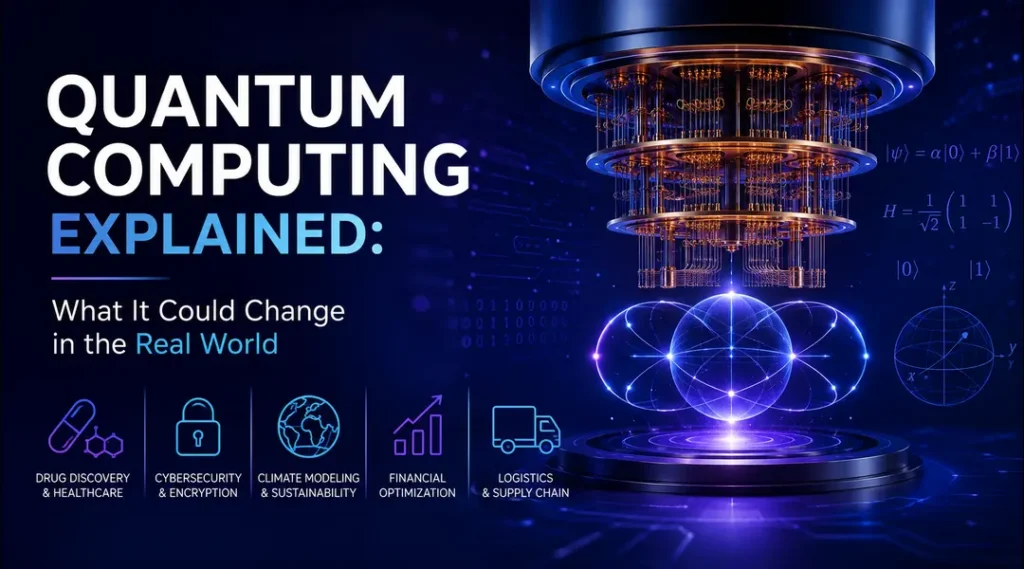
Quantum computing is one of the most exciting areas of modern technology, but it is also one of the easiest to misunderstand. Headlines often make quantum computers sound like machines that will replace ordinary computers overnight. The reality is much more interesting.
Quantum Computing Explained means understanding both the potential and the limitations of this emerging technology. Quantum computers are designed to solve certain types of problems in fundamentally different ways from traditional computers. If researchers can build reliable, large scale quantum systems, they could influence fields such as medicine, cybersecurity, finance, materials science, logistics, and artificial intelligence.
However, most of these applications are still being researched. Today’s quantum computers are not replacements for your laptop or smartphone. Instead, researchers are working toward specialized machines that could eventually tackle problems that are extremely difficult for classical computers.
So, what exactly is quantum computing, and what could it change in the real world?
What Is Quantum Computing?
Traditional computers process information using bits. A bit has a value of either 0 or 1. Billions of these simple operations can be combined to run everything from websites and mobile apps to scientific simulations.
Quantum computers use qubits, or quantum bits. Qubits can take advantage of quantum mechanical properties such as superposition and entanglement.
Superposition allows a quantum system to represent combinations of possible states, while entanglement creates strong correlations between quantum systems. Quantum algorithms use these properties in carefully designed ways to perform particular calculations.
That does not mean a quantum computer simply tries every possible answer at the same time and automatically chooses the correct one. The real advantage comes from designing quantum operations so that useful answers become more likely through quantum interference.
This distinction is important because quantum computing is not universally faster than classical computing.
A powerful classical computer will remain the better choice for many everyday tasks.
How Is a Quantum Computer Different From a Normal Computer?
The biggest difference is how information is represented and processed.
A classical computer uses bits and well established logic operations. A quantum computer uses qubits and quantum operations.
Another important difference is error. Qubits are extremely sensitive to their environment. Heat, electromagnetic interference, imperfections in hardware, and other effects can disturb quantum information.
This makes quantum error correction one of the most important areas of research.
Researchers are developing techniques that use multiple physical qubits to create more reliable logical qubits. The goal is to reduce errors enough that increasingly complex quantum calculations can be performed accurately.
Recent progress has been significant. Google reported that its Willow quantum chip demonstrated an important improvement in quantum error correction, with errors decreasing as the size of its error correcting system increased. Google also reported a benchmark calculation completed in under five minutes that it said would take a leading classical supercomputer an extraordinarily long time.
These results are important research milestones, but they should not be interpreted as meaning quantum computers are already faster than classical computers for ordinary real world workloads.
Why Does Quantum Computing Matter?
The main reason quantum computing matters is that some problems become extremely difficult as their size increases.
For example, simulating the behavior of molecules can require enormous computational resources because nature itself operates according to quantum mechanics.
A sufficiently capable quantum computer could eventually make certain molecular simulations more practical.
This could have implications for chemistry, medicine, materials science, energy research, and manufacturing.
The key phrase is certain problems.
Quantum computing is expected to be a specialized technology rather than a universal replacement for classical computing.
Quantum Computing in Healthcare and Drug Discovery
One of the most promising potential applications is drug discovery.
Developing a new medicine can involve studying how molecules interact with proteins and other biological structures. Classical computers already play an important role in this process, but accurately modeling complex molecular systems can become computationally expensive.
Quantum computers may eventually help researchers simulate chemical systems more naturally because quantum systems themselves follow the laws of quantum mechanics.
Researchers are exploring quantum algorithms for molecular simulation, electronic structure calculations, and related chemistry problems. Scientific literature suggests that quantum computing could become useful for increasingly complex pharmaceutical calculations as error corrected quantum hardware improves.
The practical impact could include better understanding of molecular behavior, improved drug candidates, and potentially faster research cycles.
It is important to keep expectations realistic, though. Quantum computing has not suddenly made drug discovery instant. Most useful applications still require significant advances in hardware, algorithms, and error correction.
Quantum Computing Could Change Materials Science
New materials are important for batteries, electronics, renewable energy systems, aerospace, construction, and many other industries.
Finding better materials often requires understanding how atoms and electrons behave.
Quantum computing could help scientists model certain complex materials and chemical reactions that are difficult to simulate using conventional methods.
For example, researchers could eventually investigate materials with properties useful for better batteries, more efficient catalysts, or advanced electronic devices.
The long term value could be substantial because even a relatively small improvement in a material can affect an entire industry.
Quantum Computing and Cybersecurity
Cybersecurity may be one of the areas where quantum computing creates both opportunity and risk.
Some widely used public key cryptographic systems depend on mathematical problems that are extremely difficult for classical computers to solve. A sufficiently powerful quantum computer could threaten some of these systems.
The threat is not necessarily immediate, because building a cryptographically relevant quantum computer remains a major technical challenge.
Nevertheless, organizations are already preparing.
The U.S. National Institute of Standards and Technology has finalized post quantum cryptography standards designed to protect information against future quantum attacks. NIST recommends that organizations begin transitioning to these newer standards rather than waiting for a large scale quantum computer to arrive.
This is particularly important for information that needs to remain confidential for many years.
A related concern is sometimes described as harvest now, decrypt later. An attacker could collect encrypted information today and attempt to decrypt it in the future if sufficiently powerful quantum technology becomes available.
For businesses, governments, and technology providers, preparing for this possibility is becoming part of long term cybersecurity planning.
Quantum Computing Could Influence Finance
Financial institutions deal with complex problems involving risk, optimization, pricing, portfolios, and market simulations.
Quantum algorithms may eventually help with some of these computational challenges.
For example, portfolio optimization can involve choosing combinations of investments while balancing risk and expected returns under many constraints. Large optimization problems can become increasingly difficult as the number of possible combinations grows.
Quantum optimization methods are being researched as one possible way to approach some of these problems.
However, financial institutions should not assume that quantum computers will automatically produce better investment decisions. Real financial systems involve noisy data, regulations, unpredictable human behavior, and many practical constraints.
Quantum computing could become another tool in the financial technology ecosystem rather than a magic solution.
Quantum Computing and Artificial Intelligence
The relationship between quantum computing and artificial intelligence is another major area of research.
AI systems increasingly require large amounts of computational resources for training, optimization, and simulation. Researchers are investigating whether quantum algorithms could eventually accelerate specific parts of machine learning.
This area is often called quantum machine learning.
It is still an emerging research field, and there is no general evidence that today’s quantum computers can replace the powerful classical hardware used for modern AI.
Instead, the more realistic long term possibility is a hybrid model.
Classical computers could handle most AI workloads while quantum processors are used for particular mathematical or optimization tasks where they provide an advantage.
As AI continues to evolve through developments such as the Rise of AI Agents, quantum computing could become an additional research direction for solving specialized optimization and simulation problems.
Quantum Computing Could Improve Logistics and Optimization
Imagine a company managing thousands of deliveries.
It needs to determine which vehicles should visit which locations, in what order, while considering traffic, fuel costs, delivery windows, driver availability, and other constraints.
This is an optimization problem.
Similar challenges appear in airline scheduling, warehouse management, manufacturing, telecommunications, and supply chain planning.
Quantum computing researchers are exploring ways to represent certain optimization problems in forms that quantum processors can work with.
If useful quantum advantage is achieved for some of these problems, businesses could potentially find better solutions or evaluate large numbers of possible scenarios more efficiently.
Again, the goal is not to make every calculation quantum. The goal is to identify problems where quantum algorithms offer a genuine advantage.
Will Quantum Computers Replace Classical Computers?
Probably not.
A better way to think about the future is that classical and quantum computers will work together.
Your smartphone will still need classical processors for operating systems, applications, web browsing, video, communication, and everyday tasks.
A quantum processor could act more like a specialized accelerator.
This is similar to how modern computers already combine different types of processors. A central processor handles general tasks, while specialized hardware can accelerate graphics, machine learning, or other workloads.
Quantum computers could eventually become another specialized component in this broader computing ecosystem.
What Are the Biggest Challenges?
The potential of quantum computing is enormous, but several major challenges remain.
Qubit Stability
Qubits are sensitive and can lose their quantum state through interactions with their environment.
Error Correction
Useful quantum computing requires reliable methods for detecting and correcting errors without destroying the quantum information being processed.
Scaling
Building a small quantum processor is very different from building a large machine with enough reliable logical qubits to solve commercially valuable problems.
Software Development
Quantum algorithms require different approaches from traditional programming. Researchers need better software tools, compilers, algorithms, and development environments.
Proving Real World Advantage
A quantum computer being faster at a carefully selected benchmark does not automatically mean it will outperform classical systems in useful business applications.
The industry ultimately needs practical demonstrations where quantum computing provides a measurable advantage over the best available classical approaches.
When Will Quantum Computing Become Useful?
There is no single date when quantum computing will suddenly become useful.
Different applications will mature at different speeds.
Some quantum technologies are already being used for research and experimentation through cloud accessible quantum processors. At the same time, researchers are still working toward fault tolerant systems capable of performing long and complex calculations reliably.
The current direction of the industry suggests that progress will be gradual.
Hardware improvements, better error correction, improved algorithms, and classical quantum hybrid systems are all likely to contribute.
For businesses, the sensible approach is to understand the technology now rather than make unrealistic predictions about a specific future date.
What Could Quantum Computing Change for Everyday People?
You may never directly open a quantum computing app, but the effects could appear indirectly.
A new medicine developed with better molecular simulation could improve healthcare.
A more efficient battery could change electric transportation and energy storage.
Improved optimization could reduce delivery costs or make supply chains more efficient.
Post quantum security could help protect personal information against future cyber threats.
New materials could improve electronics and industrial products.
In other words, the biggest impact of quantum computing may happen behind the scenes.
The Future of Quantum Computing
The most important thing to understand about quantum computing is that it is not simply a faster version of the computer sitting on your desk.
It is a fundamentally different approach to computation that may be exceptionally powerful for specific classes of problems.
The technology still faces significant engineering and scientific challenges. At the same time, progress in quantum hardware and error correction is making the field increasingly important to researchers, governments, and businesses.
For anyone interested in technology, learning the basics now is worthwhile.
Quantum Computing Explained in simple terms comes down to one idea: quantum computers use the unusual behavior of quantum systems to approach certain computational problems in new ways.
The technology may eventually influence medicine, materials, finance, cybersecurity, logistics, and AI.
But the real story is not about replacing classical computers.
It is about creating a new type of computational tool and discovering where that tool can provide an advantage.
That is what makes quantum computing so promising, and also why its future remains one of the most fascinating questions in technology.