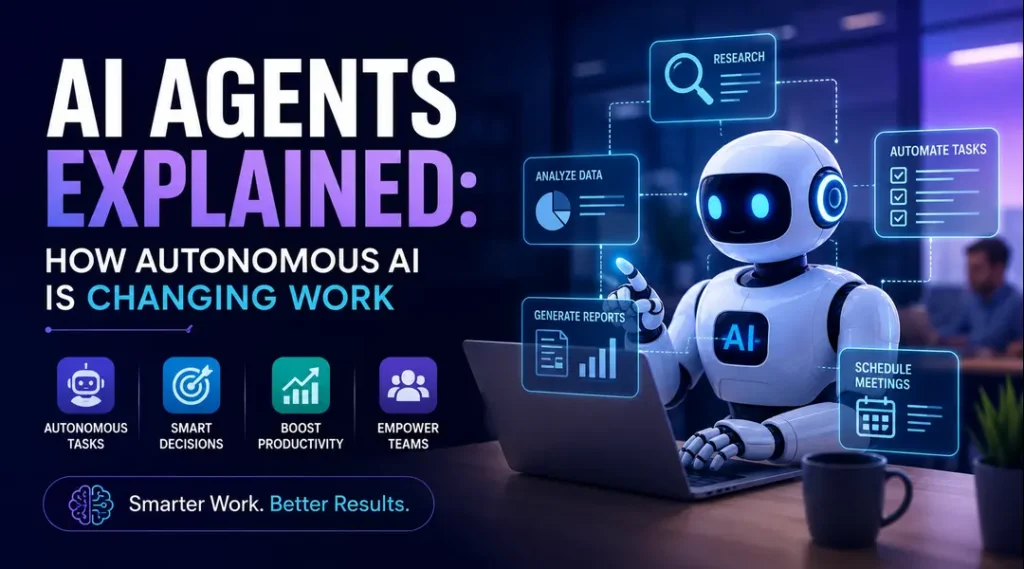
Artificial intelligence is moving beyond simple chatbots and content generation. A new generation of AI systems can understand a goal, plan the required steps, use digital tools, and complete tasks with much less human involvement. These systems are commonly called AI agents.
The idea behind AI agents is simple. Instead of asking an AI tool to perform one action at a time, you can give an agent a broader objective and allow it to work through the process. This shift is changing how businesses think about automation, productivity, customer service, software development, research, and many other types of work.
But what exactly are AI agents, how do they work, and what can businesses realistically expect from them?
This guide provides a practical AI Agents Explained overview for anyone who wants to understand autonomous AI without getting lost in technical terminology.
What Are AI Agents?
AI agents are software systems designed to achieve a specific goal by understanding information, making decisions, using tools, and taking actions.
A traditional chatbot generally follows a simple pattern. You ask a question, the system generates an answer, and the interaction ends.
An AI agent can take the process further. For example, imagine asking an agent to research potential customers for a business. Instead of only giving you a list of ideas, the agent could gather information from approved sources, organize the findings, prepare a report, and identify which prospects may deserve attention.
The important difference is action.
AI agents can connect artificial intelligence with software applications, databases, APIs, search systems, business tools, and other digital resources. Depending on their design and permissions, they can complete several related tasks as part of one workflow.
How Do AI Agents Work?
An AI agent usually combines several capabilities to complete a goal.
1. Understanding the Goal
The agent first interprets the instruction provided by a person or another system.
For example, a manager could ask an agent to prepare a weekly sales summary. The agent needs to understand what information is required, which sources should be used, and what the final result should look like.
2. Planning the Task
Instead of immediately producing an answer, the agent can break a larger objective into smaller actions.
For a sales report, those actions might include collecting data, checking the numbers, comparing the current period with previous results, identifying important changes, and preparing a summary.
3. Using Tools
An agent becomes more useful when it can interact with approved tools.
Depending on its permissions, an AI agent may work with databases, calendars, spreadsheets, customer relationship management systems, development environments, search tools, or internal company applications.
This ability allows the agent to move from generating information to completing useful work.
4. Checking Results
A well designed agent can evaluate the results of its actions before continuing.
For example, if a required file is missing, the agent may recognize the problem and request human assistance instead of pretending the task is complete.
This feedback process is important because autonomous systems can make mistakes. Giving an agent the ability to verify information and follow defined rules can make its workflow more reliable.
5. Taking Action
After planning and checking, the agent can perform the next approved action.
The level of independence depends on how the system is configured. Some agents may require approval before important actions, while others can complete low risk tasks automatically.
AI Agents vs Traditional Automation
Traditional automation is usually based on predefined instructions.
For example, a company might create an automation that sends an email whenever a customer completes a specific form. The workflow follows fixed rules.
AI agents can handle situations where the exact path is not known in advance.
Suppose a customer sends a complicated support request. An agent could read the request, identify the issue, search approved knowledge sources, review the customer’s history, prepare a response, and escalate the case if it falls outside the permitted rules.
This does not mean AI agents replace every form of automation. Traditional automation is often faster, predictable, and easier to control for simple repetitive processes.
AI agents are more valuable when a workflow requires interpretation, planning, decision making, and interaction with several systems.
How Autonomous AI Is Changing Work
The biggest change created by autonomous AI is the shift from task assistance to task delegation.
Instead of using AI only to help complete individual activities, businesses can increasingly use AI systems to manage complete workflows.
Customer Service
AI agents can help classify support requests, find relevant information, summarize customer conversations, and prepare responses.
For simple cases, an agent may resolve the request automatically. More sensitive or complicated issues can be transferred to a human employee.
This model can reduce repetitive work while allowing employees to focus on situations that require judgment and empathy.
Software Development
Software teams can use AI agents for tasks such as investigating bugs, reviewing code, creating tests, documenting software, and researching technical problems.
The agent does not necessarily replace the developer. Instead, it can handle time consuming parts of the development process while developers remain responsible for architecture, quality, security, and final decisions.
Marketing
Marketing teams can use agents to research topics, organize campaign information, analyze performance data, prepare content ideas, and assist with customer research.
Human review remains important because brand reputation, factual accuracy, and audience understanding cannot always be reduced to automated decisions.
Business Operations
Operations teams often manage repetitive workflows involving spreadsheets, emails, documents, approvals, and internal systems.
AI agents can coordinate several of these activities and help employees spend more time on planning and problem solving.
Research
Research is another area where agents can be useful. An agent can gather information from approved sources, organize findings, compare information, and create a structured research summary.
However, important claims should still be verified by people, especially when decisions depend on accurate or current information.
Benefits of AI Agents for Businesses
The potential benefits of AI agents go beyond saving time.
Better Productivity
Employees can delegate repetitive workflows and focus on tasks that require creativity, communication, strategy, and professional judgment.
Faster Workflows
An agent can potentially perform several connected steps without waiting for a person to manually start each stage.
Consistent Processes
When an agent follows clear instructions and policies, it can perform repetitive processes consistently.
Around the Clock Availability
Digital agents do not need traditional working hours. This can be useful for monitoring systems, handling routine requests, or preparing information for employees.
Scalable Operations
Businesses may be able to handle more digital work without increasing every manual process at the same rate.
The actual benefit depends on the quality of the workflow, data, tools, permissions, and human oversight. AI agents are not automatically efficient simply because they are autonomous.
Risks and Limitations of AI Agents
Understanding AI Agents Explained also means understanding what can go wrong.
Incorrect Decisions
AI systems can misunderstand instructions or produce incorrect information. When an agent is allowed to take action, an incorrect decision can have greater consequences than an incorrect chatbot response.
Security Risks
Giving an AI system access to company applications creates additional security considerations.
Organizations need clear permissions, authentication, monitoring, data protection, and rules about which actions an agent can perform. Businesses exploring this area should also understand topics such as AI Agents in Cybersecurity.
Privacy Concerns
Agents may interact with customer records, internal documents, emails, or other sensitive information. Companies should carefully control what data agents can access and how that data is stored and processed.
Overdependence on Automation
Employees should not blindly trust automated decisions. Human review is especially important for financial, legal, employment, security, and other high impact decisions.
Unexpected Behavior
An agent may interpret a goal differently from what its creator intended. A system focused too strongly on completing a task may choose an undesirable shortcut.
For this reason, responsible AI deployment should include clear boundaries and approval processes.
Why Human Oversight Still Matters
Autonomous does not mean completely independent or always correct.
The strongest approach for many organizations is human and AI collaboration. AI agents can handle repetitive processes while people supervise important decisions.
For example, an agent might prepare a financial report, but a finance professional reviews the numbers before the report is distributed.
An agent might identify a security alert, but a security specialist decides how to respond.
An agent might draft a customer response, but an employee approves sensitive communications.
This approach allows businesses to gain the productivity benefits of AI while maintaining accountability.
What Skills Will Become More Important?
The growth of AI agents does not mean that every human skill becomes less valuable.
In many workplaces, the importance of certain skills may increase.
People will need to understand how to define goals clearly, evaluate AI output, verify information, manage workflows, protect data, and make decisions when automation reaches its limits.
Communication and critical thinking will remain important because humans still need to determine what should be automated and what should remain under human control.
Employees who understand both their professional field and AI capabilities may be especially valuable because they can identify practical opportunities for responsible automation.
What Is the Future of AI Agents?
AI agents are likely to become more integrated into everyday software and business processes.
Instead of opening separate applications and completing every step manually, employees may increasingly describe the outcome they need and allow AI systems to coordinate approved tools in the background.
We may also see multiple specialized agents working together. One agent could handle research, another could analyze information, and another could prepare the final output.
However, the future of autonomous AI will depend on more than intelligence. Reliability, security, privacy, transparency, and accountability will be equally important.
Technologies such as advanced computing may also influence future AI development. Readers interested in emerging computing concepts can explore Quantum Computing Explained to understand how quantum technologies differ from traditional computing.
How Businesses Can Start Using AI Agents
Businesses do not need to automate an entire department immediately.
A better starting point is to identify one repetitive and measurable workflow.
Look for a process that has clear inputs, predictable objectives, approved data sources, and a defined outcome.
For example, a company could begin with internal research summaries or routine document organization.
Next, establish clear permissions. Decide what the agent can read, what it can change, and which actions require human approval.
Finally, measure the results. Track factors such as time saved, error rates, quality, employee satisfaction, and customer outcomes.
If the system performs reliably, the organization can gradually expand its responsibilities.
Final Thoughts
AI agents represent an important change in how people interact with artificial intelligence.
The technology is moving from systems that simply answer questions toward systems that can understand goals, plan tasks, use tools, and complete workflows.
That does not mean humans are becoming unnecessary. In many cases, the most valuable future is one where people set goals, provide context, review important decisions, and remain accountable while AI handles repetitive digital work.
The key is to treat autonomous AI as a powerful technology that needs clear boundaries rather than as a perfect replacement for human judgment.
When businesses combine capable AI agents with strong security, responsible data practices, human oversight, and measurable goals, autonomous AI can become a practical tool for improving the way modern work gets done.
Frequently Asked Questions
Are AI agents the same as chatbots?
No. A chatbot primarily responds to user prompts, while an AI agent can be designed to plan and execute multiple actions toward a specific goal.
Can AI agents replace employees?
AI agents can automate some tasks that employees currently perform, but that does not mean every job can or should be replaced. Many roles require judgment, creativity, responsibility, communication, and human relationships.
Are AI agents safe?
AI agents can be useful when they operate within appropriate security controls and permissions. However, they can also create risks if they have excessive access, unclear instructions, poor monitoring, or inadequate human oversight.
What is agentic AI?
Agentic AI refers to AI systems designed to pursue goals and take actions with a certain level of autonomy. AI agents are a common example of this approach.
Should small businesses use AI agents?
Small businesses can benefit from AI agents when they have repetitive workflows that are suitable for automation. Starting with a limited, low risk process is generally more practical than attempting to automate everything at once