Video games have always been driven by creativity, technology, and the desire to create experiences that feel more immersive. Today, artificial intelligence is becoming one of the most important technologies shaping that process.
From designing game worlds to testing gameplay and creating smarter characters, AI is changing how developers build games. It is also helping teams handle repetitive tasks, understand player behavior, and experiment with new ideas more quickly.
However, AI is not simply replacing traditional game development. Instead, it is becoming another tool that developers can use alongside programming, art, design, writing, sound, and human creativity.
The impact of AI on Video Game Development is already visible, and its role is likely to become even more important as game engines, development tools, and AI models continue to improve.
What Is AI in Video Game Development?
AI in game development refers to the use of artificial intelligence technologies to help create, test, manage, or improve video games.
Traditional game development often requires large teams to spend significant amounts of time on repetitive work. Developers may need to test the same mechanic hundreds of times, artists may create many similar assets, and designers may manually adjust game environments.
AI can assist with some of these tasks.
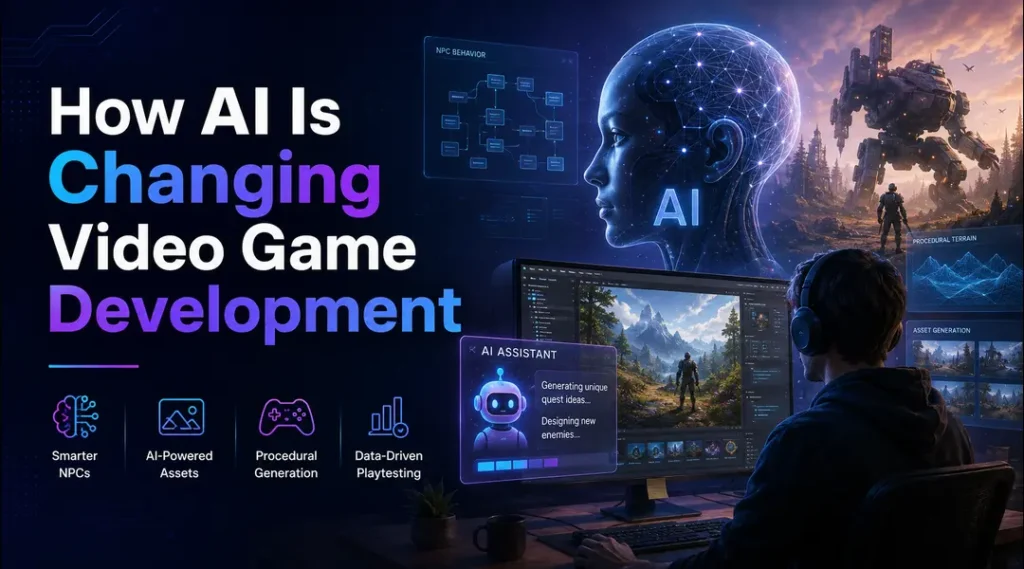
For example, AI tools can help developers generate ideas, analyze large amounts of gameplay data, create variations of assets, identify bugs, and build more responsive game characters.
The important point is that AI works best as an assistant. Human developers still make the creative and technical decisions that determine how a game feels and what experience it provides.
How AI Is Transforming Game Design
Game design is one of the areas where AI can provide valuable support.
Developers can use AI to explore different gameplay concepts, generate early ideas, and experiment with game mechanics. Instead of spending hours creating every possible variation manually, a development team can use AI to explore multiple possibilities and then select the ideas that fit the game’s vision.
AI can also help with procedural content generation. This approach allows systems to create elements such as environments, missions, items, or challenges based on predefined rules.
For large games, this can be particularly useful because developers can create more content without manually designing every small element.
However, generated content still needs human review. A game can technically contain a huge amount of content while still feeling repetitive or uninteresting. Good game design depends on pacing, balance, storytelling, and player psychology, which require thoughtful human decisions.
Smarter NPCs and Game Characters
Non playable characters are another major area where AI is making a difference.
In older games, characters often followed predictable patterns. They might walk along fixed routes, attack when a player entered a specific area, or repeat the same dialogue.
Modern AI systems can make NPC behavior more flexible.
Developers can design characters that respond to player actions, choose different strategies, and react to changing situations. This can make game worlds feel more dynamic because players are not always experiencing exactly the same behavior.
For example, an AI controlled enemy could change its strategy after noticing how a player behaves. A companion character could react differently depending on the player’s previous actions.
This type of adaptive behavior can make games feel more personal and unpredictable.
At the same time, developers need to carefully control AI behavior. Characters should still behave in ways that make sense within the game’s world. Completely unpredictable behavior can sometimes damage the gameplay experience instead of improving it.
AI Is Making Game Testing Faster
Testing is one of the most time consuming parts of game development.
A modern video game can contain thousands of interactions, systems, environments, items, characters, and possible player actions. Finding every bug through manual testing can be extremely difficult.
AI can help automate parts of this process.
AI powered testing systems can simulate different player behaviors and identify unusual situations. They can help developers discover problems that might not appear during normal testing sessions.
For example, an automated system could repeatedly test menus, combat systems, character movement, or specific gameplay scenarios.
This does not mean human testers are no longer important. Human players can recognize problems related to fun, frustration, difficulty, usability, and overall experience that automated systems may not understand.
The strongest approach combines automated testing with human quality assurance.
AI and Game Graphics
Visual development is another area being influenced by artificial intelligence.
Creating high quality game assets can require significant time and specialized skills. AI assisted tools can help artists explore concepts, create references, generate variations, or speed up parts of the asset creation process.
AI can also support tasks related to animation, image processing, texture creation, and environment design.
For smaller development teams, these tools can be particularly useful because they may allow a limited team to experiment with ideas that would otherwise require more resources.
Still, generated visuals should not automatically be treated as finished game assets. Developers and artists need to review them for consistency, technical quality, visual style, and originality.
A game needs a coherent artistic identity, and that usually requires human direction.
AI Can Improve Game Development Workflows
One of the biggest advantages of AI may not be a specific feature inside a game. It may be the way AI helps development teams work.
Developers can use AI assistants for tasks such as explaining code, creating documentation, identifying possible errors, generating test cases, or exploring programming solutions.
Designers can use AI to organize ideas and evaluate different gameplay concepts. Writers can use it for brainstorming dialogue structures or character concepts. Producers can use AI assisted tools to organize information and identify workflow problems.
This can reduce time spent on repetitive tasks and allow teams to focus more attention on creative decisions.
However, developers should always review AI generated code and content. AI can produce incorrect logic, security problems, inefficient solutions, or content that does not match the project’s requirements.
Human knowledge remains essential.
Personalized Gaming Experiences
AI can also change how players experience games.
A game can collect information about how players interact with different systems. With appropriate privacy practices and player consent, developers can use this information to understand gameplay patterns and improve experiences.
AI systems may eventually help games adjust difficulty, recommendations, challenges, or other elements based on individual play styles.
Imagine a game that recognizes when a player is struggling with a particular mechanic and adjusts the experience in a subtle way. Another player who prefers difficult challenges could receive a different experience.
This type of personalization could make games more accessible and engaging.
However, personalization needs to be designed responsibly. Developers should be transparent about data practices and avoid creating systems that manipulate players into unwanted spending or excessive play.
AI and Game Development for Smaller Studios
Large studios are not the only companies that can benefit from AI.
Independent developers and small teams may find AI especially useful because they often work with limited budgets and smaller production teams.
A small studio could use AI assisted tools for brainstorming, basic testing, documentation, programming support, or early concept development.
This can help developers spend more time on the parts of their games that make them unique.
For example, an independent developer might use AI to speed up repetitive technical tasks while spending more time designing the game’s story, mechanics, and visual identity.
This could lower some development barriers, although building a successful game still requires strong planning, technical skills, creativity, testing, and marketing.
The Role of AI in Esports and Competitive Games
AI is also relevant to competitive gaming.
Developers can use AI to analyze gameplay patterns, identify balance problems, and test different game mechanics. This can be especially useful in competitive games where even a small balance issue can affect the overall experience.
AI based systems can help teams and developers study player behavior and identify patterns that may be difficult to detect manually.
For readers interested in competitive gaming, exploring topics such as Top Esports Games can also provide useful context about how game design, balance, player skill, and competitive systems come together.
The future of competitive games may involve even more advanced analysis tools, although human coaching and player judgment will remain important.
What AI Cannot Replace in Game Development
Despite its rapid progress, AI has important limitations.
A successful game is more than a collection of assets, code, and automated systems. Great games often come from strong creative direction and a clear understanding of what players should feel.
Human developers bring personal experiences, cultural perspectives, storytelling ability, emotional understanding, and creative judgment.
AI can generate possibilities, but deciding which possibility is worth building is still a human responsibility.
There are also concerns about originality, copyright, data privacy, transparency, and the use of AI generated content. Development teams need clear policies to make sure their use of AI respects applicable laws, licenses, platform requirements, and the rights of creators.
For these reasons, responsible AI adoption is likely to become just as important as technical innovation.
How AI Could Shape the Future of Video Game Development
The future of Video Game Development will probably involve a combination of human creativity and increasingly capable AI systems.
Developers may be able to build larger and more responsive worlds while spending less time on repetitive production tasks. NPCs could become more reactive, testing could become more automated, and development tools could become more personalized.
We may also see more AI assisted tools designed specifically for game engines. These tools could help developers move from an idea to a working prototype more quickly.
The biggest change may be the speed of experimentation. Developers could test more ideas, reject weak concepts earlier, and spend more time improving the ideas that show potential.
This does not necessarily mean every future game will be created primarily by AI. Instead, AI may become a standard part of the development toolkit, similar to other technologies that have changed the industry over time.
What This Means for Players
For players, the impact of AI may appear gradually.
They may notice characters that respond more naturally, worlds with more variation, better game testing, smarter difficulty systems, and faster updates.
Players may also benefit from improved accessibility and personalization.
At the same time, players will continue to care about the things that have always made games enjoyable: memorable stories, satisfying mechanics, beautiful worlds, interesting characters, and meaningful choices.
Technology can help developers create these experiences, but it cannot guarantee that a game will be fun.
That still depends on good design.
Final Thoughts
AI is becoming an important part of modern Video Game Development, but it should be viewed as a tool rather than a replacement for developers.
From game design and NPC behavior to testing, graphics, programming, and personalization, AI can help development teams work faster and explore new possibilities.
The most successful approach will likely be a balanced one. Developers can use AI for repetitive and complex tasks while keeping human creativity, judgment, and responsibility at the center of the process.
As AI technology continues to improve, the gaming industry will have more opportunities to create richer worlds and more personalized experiences. For players, that could lead to games that feel more responsive, dynamic, and engaging than ever before.
If you also enjoy discovering new titles across different genres and platforms, exploring Best Steam Games can be a useful next step after understanding how modern technology is influencing the games we play.