
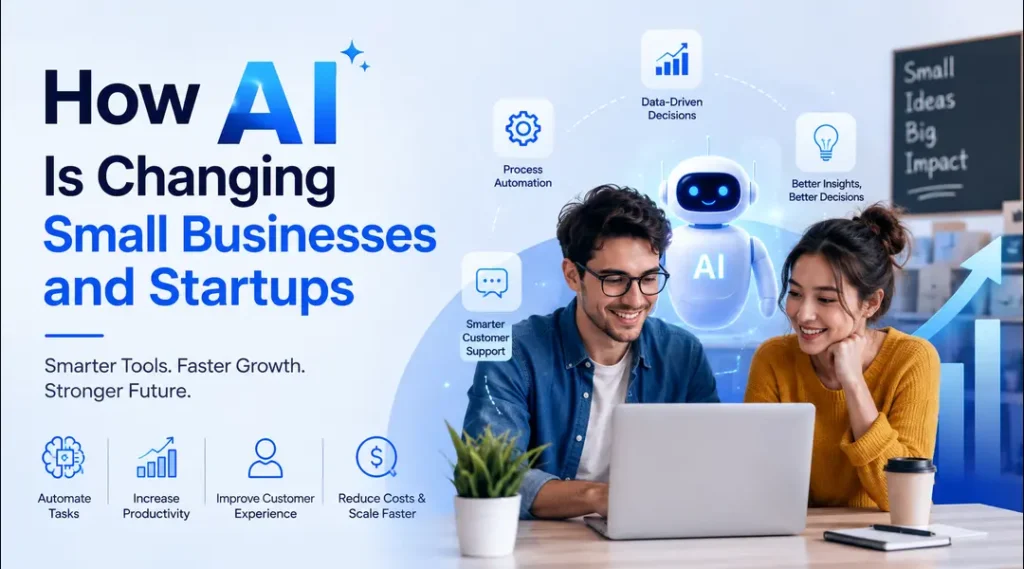
Artificial intelligence is no longer limited to large technology companies with huge budgets and specialized teams. Today, small businesses and startups can use AI tools to automate repetitive work, understand customers, create content, improve operations, and make faster business decisions.
This shift explains why AI Is Changing Small Businesses and Startups so quickly. A business with a small team can now access tools that once required significant time, money, and technical expertise.
The biggest opportunity is not simply using AI because it is popular. The real advantage comes from identifying everyday business problems and using AI to solve them in a practical and responsible way.
For small business owners and startup founders, this can mean more productive teams, lower operating costs, better customer service, and more time to focus on growth.
Why AI Matters for Small Businesses
Small businesses often work with limited resources. One person may handle marketing, customer support, administration, sales, research, and operations at the same time.
AI can help reduce this pressure by assisting with tasks that are repetitive, time consuming, or data heavy.
For example, a small company can use AI to help organize customer questions, summarize documents, draft marketing ideas, analyze business data, or create an initial version of a report.
The important point is that AI does not have to replace the people running a business. In many cases, it works best as a support system that helps people work more efficiently.
Google also emphasizes the importance of original, useful, relevant content and a good user experience for sites using AdSense.
How AI Is Changing Small Businesses and Startups
The impact of AI can be seen across almost every part of a modern business.
1. AI Makes Everyday Tasks Faster
Administrative work can consume a surprising amount of time.
Small businesses regularly deal with emails, meeting notes, invoices, reports, customer questions, product descriptions, research, and internal documents.
AI can assist with many of these activities. A business owner can use an AI tool to summarize a long document, organize information, create a first draft, or turn notes into a structured plan.
This gives employees more time to focus on tasks that require human judgment, communication, creativity, and decision making.
The goal should not be to automate everything. Businesses should identify repetitive activities where AI can provide useful assistance without reducing quality.
2. AI Helps Businesses Understand Customers
Understanding customers is one of the most important parts of building a successful business.
AI can help businesses analyze customer feedback, reviews, survey responses, support conversations, and other information. Patterns that might take hours to identify manually can sometimes become easier to recognize with AI assistance.
For example, a business might discover that customers frequently ask about delivery times. That insight could encourage the company to improve its delivery information or create a clearer FAQ section.
Startups can also use customer insights to improve products and identify opportunities for future growth.
However, businesses should always review AI generated conclusions carefully. Customer data can contain context that an automated system may misunderstand.
3. AI Is Improving Customer Service
Customer expectations are changing. People increasingly want quick and helpful answers when they have questions.
AI can support customer service by helping businesses organize frequently asked questions, draft responses, classify support requests, and provide basic assistance.
A small online store, for example, could use an AI supported system to help customers find information about shipping, returns, product features, or order processes.
This can reduce the workload for a small customer service team.
Human support is still important, especially when a customer has a complicated problem or needs a personalized solution. The best approach is often a combination of AI assistance and human oversight.
4. AI Helps With Marketing and Content Creation
Marketing is another area where small businesses can benefit from AI.
Creating content consistently can be challenging when a company has only a few employees. AI can help generate ideas for blog topics, social media posts, email campaigns, product descriptions, and content outlines.
It can also help marketers analyze existing content and identify areas for improvement.
However, businesses should avoid publishing generic AI content without human review. Search engines and users both benefit from content that offers genuine value, experience, useful information, and original insights.
Google’s AdSense guidance specifically highlights the importance of unique and relevant content that provides value to users.
For that reason, AI should be treated as a tool for research, brainstorming, and productivity rather than a shortcut for producing large amounts of low value content.
5. AI Can Reduce Operating Costs
Cost control is especially important for startups and small companies.
AI can help reduce the amount of manual work required for certain business processes. When repetitive tasks become more efficient, employees can spend more time on activities that directly contribute to revenue and customer satisfaction.
For example, a small marketing agency could use AI to organize research and prepare first drafts while its team focuses on strategy and client relationships.
A retailer could use AI to identify patterns in sales data and improve inventory planning.
The savings will vary from business to business, but even small efficiency improvements can become meaningful when repeated every day.
6. AI Supports Better Business Decisions
Business owners make decisions based on information from sales, customers, finances, marketing, competitors, and operations.
AI can help organize large amounts of information and highlight patterns that deserve attention.
For example, an owner might analyze monthly sales data to identify products that are performing well or periods when demand tends to increase.
AI can also help create different scenarios for planning. A business might ask what could happen if it increases its marketing budget, changes its pricing, or introduces a new product.
These tools can support decision making, but they should not replace responsible judgment. Business owners should verify important information and consider financial, legal, customer, and operational factors before taking action.
7. AI Is Creating New Opportunities for Startups
Startups often succeed by solving a specific problem in a better or faster way.
AI is creating opportunities for entrepreneurs to develop new services, improve existing products, and build businesses around specialized customer needs.
A founder might create an AI supported research service, an automated customer support solution, a business analytics product, or a specialized productivity tool.
At the same time, entrepreneurs do not always need to build an AI company to benefit from the technology.
A traditional business can use AI to improve its existing model. This creates opportunities across industries such as retail, education, consulting, marketing, professional services, hospitality, and ecommerce.
For entrepreneurs exploring a Profitable Online Business, AI can become a useful part of research, content development, customer communication, and operational workflows.
8. AI Is Changing the Skills Businesses Need
As AI becomes more common, the skills required in the workplace are also changing.
Employees may need to become comfortable with AI tools while continuing to develop skills that machines cannot easily replace.
Critical thinking, creativity, communication, leadership, problem solving, relationship building, and industry knowledge remain important.
A successful team will not necessarily be the team that uses the most AI tools. It will often be the team that knows when to use them and when human expertise is more appropriate.
Business owners should therefore focus on training employees instead of simply purchasing new technology.
Challenges of Using AI in Small Businesses
AI offers significant benefits, but it also comes with risks.
Accuracy and Reliability
AI systems can produce incorrect information. Important business decisions should not depend on unverified AI output.
Employees should review important facts, numbers, recommendations, and customer facing information before using them.
Privacy and Data Protection
Businesses should be careful about entering sensitive customer, employee, financial, or confidential business information into AI services.
Before adopting an AI tool, companies should understand how data is handled and what security controls are available.
Cost and Tool Selection
Not every AI tool is worth paying for.
Businesses should start with a specific problem and determine whether AI actually improves the process. Buying multiple tools without a clear purpose can create unnecessary costs and complexity.
Human Oversight
AI should support responsible decision making rather than remove accountability.
A human should remain involved in important areas such as customer complaints, financial decisions, hiring, legal matters, and sensitive business communications.
How Small Businesses Can Start Using AI
A practical approach is better than trying to transform an entire business overnight.
Start With One Repetitive Task
Identify a task that consumes time every week. This could be email organization, content research, meeting summaries, customer questions, or reporting.
Measure the Result
Before using AI, estimate how much time the task normally takes. After introducing the tool, compare the results.
Ask whether the process became faster, cheaper, or better.
Keep Humans in the Process
Use AI for assistance while keeping people responsible for reviewing important output.
Protect Business Information
Create clear rules about what employees can and cannot share with AI systems.
Improve Gradually
Once one workflow works well, look for another opportunity. This approach makes AI adoption easier to manage and easier to evaluate.
The Future of AI for Small Businesses
AI adoption is likely to become a normal part of business operations rather than a separate technology project.
As tools become easier to use, more small companies will integrate AI into marketing, customer service, research, administration, sales, analytics, and product development.
This does not mean every business needs to use the newest AI application. Instead, successful companies will focus on practical results.
The most important question will be simple: Does this technology help us serve customers better, save useful time, reduce unnecessary costs, or make better decisions?
Businesses that can answer yes will have a stronger reason to continue investing in AI.
These developments are also becoming an important part of wider Business Trends, as technology increasingly influences how companies compete, communicate, and operate.
Final Thoughts
AI Is Changing Small Businesses and Startups by giving smaller teams access to powerful tools for productivity, customer service, marketing, research, and decision making.
The biggest advantage is not simply automation. It is the ability to help people spend more time on valuable work.
For small businesses and startups, the smartest approach is to start with real problems, choose useful tools, protect sensitive information, verify important results, and maintain human oversight.
AI can create new opportunities, but sustainable growth still depends on strong products, satisfied customers, responsible decisions, and valuable human expertise.
Businesses that combine those strengths with practical AI adoption can build more efficient operations while staying focused on what matters most: creating real value for their customers.