Technology is moving faster than ever, but the biggest changes over the next five years may not come from one breakthrough alone. Instead, several technologies are developing at the same time and increasingly working together.
The World Economic Forum’s 2026 Technology Convergence Report highlights this shift, pointing to the growing combination of artificial intelligence, robotics, spatial intelligence, quantum computing, advanced materials, engineering biology, omni computing, and next generation energy.
For businesses, professionals, creators, and everyday users, understanding these changes can help with better decisions about skills, investments, cybersecurity, and digital strategy.
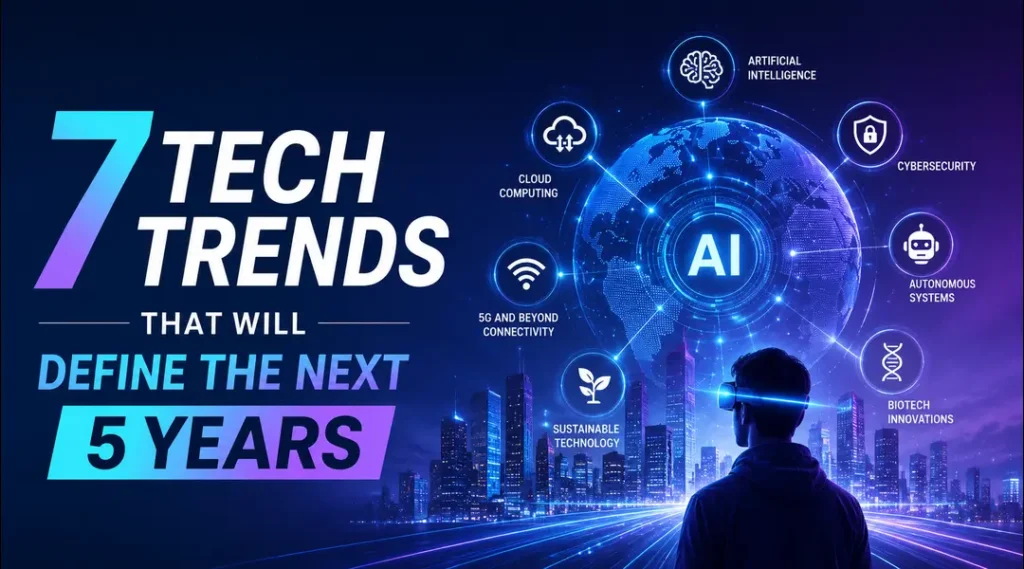
Here are seven Tech Trends that are especially likely to shape the next five years.
1. AI Agents Will Move From Assistants to Digital Teammates
Generative AI has already changed how people search, write, analyze information, create content, and solve problems. The next step is more autonomous AI agents that can plan tasks, use software, access information, and complete multi step workflows with less human intervention.
Google Cloud describes this shift as the rise of the “agentic enterprise,” where organizations move beyond basic AI assistants toward agents that can anticipate goals, reason through complex tasks, and orchestrate business processes.
Microsoft’s 2025 Work Trend Index also found that 46% of surveyed leaders said their organizations were already using agents to fully automate workstreams or business processes. Leaders expected employees to increasingly train and manage AI agents over the following five years.
What this means
AI agents could handle tasks such as:
- Researching and organizing information
- Preparing business reports
- Managing routine customer service workflows
- Monitoring operational data
- Supporting software development
- Automating repetitive administrative work
The important change is that users will increasingly tell AI what outcome they want rather than asking it to perform every individual step.
However, greater autonomy also creates new risks. Companies will need clear permissions, human oversight, audit trails, and strong data controls. This is particularly important in cybersecurity, finance, healthcare, and other areas where an incorrect automated decision can have serious consequences.
For organizations exploring this area, AI Agents in Cybersecurity is another important topic because AI powered automation and cybersecurity will increasingly overlap.
2. AI Computing Will Become More Specialized and Energy Aware
The AI boom is changing the infrastructure behind computing. Powerful GPUs and specialized AI accelerators are becoming central to modern data centers, while cloud providers are building infrastructure specifically designed for AI workloads.
This trend is about more than faster chips. It is also about how efficiently those chips can run increasingly demanding AI models.
The International Energy Agency estimates that global data center electricity consumption could more than double from around 415 TWh in 2024 to about 945 TWh by 2030 in its base case. AI is expected to be the most important driver of this increase, alongside other digital services.
That means energy efficiency will become a major technology priority.
What to expect
Over the next five years, we are likely to see more investment in:
- AI optimized processors
- Efficient model architectures
- Smaller models designed for specific tasks
- Advanced cooling systems
- Edge AI hardware
- Energy efficient data centers
- Specialized cloud infrastructure
This could also make smaller, more efficient AI models increasingly attractive. Businesses will not always need the largest model available. For many applications, a smaller model that is faster, cheaper, and easier to control may deliver better results.
The future of AI, therefore, will not simply be about building bigger models. It will also be about making intelligent computing more practical and sustainable.
3. Robotics Will Become More Intelligent and Connected
Robotics is moving beyond traditional industrial automation.
Modern robots are increasingly combining computer vision, machine learning, sensors, edge computing, and connectivity. This allows machines to understand their surroundings and respond to changing conditions rather than simply repeating a fixed sequence.
The World Economic Forum identifies robotics, AI, omni computing, and spatial intelligence as major technology domains that are increasingly converging. Its technology research also highlights connected robotic ecosystems where robots can communicate with other machines and infrastructure.
Where robotics could grow
Over the next five years, intelligent robots may become more common in:
- Warehouses and logistics
- Manufacturing
- Agriculture
- Healthcare
- Construction
- Inspection and maintenance
- Delivery operations
One important development will be better interaction between humans and robots. Instead of replacing people in every environment, robots may increasingly work alongside humans by handling physically demanding, repetitive, or hazardous tasks.
The combination of AI and robotics is especially important because AI provides the intelligence while sensors and machines provide the ability to act in the physical world.
That makes robotics one of the Tech Trends worth watching closely.
4. Cybersecurity Will Shift Toward AI and Post Quantum Protection
As technology becomes more connected and automated, cybersecurity will become even more important.
Organizations are already dealing with increasingly sophisticated threats, while AI can be used on both sides of the security equation. Defenders can use AI to detect unusual behavior, analyze large volumes of security data, identify vulnerabilities, and automate parts of incident response.
At the same time, attackers can use automation and AI to increase the speed and scale of their operations.
Another major development is post quantum cryptography.
Quantum computers are not yet replacing conventional computers for everyday tasks, but organizations are already preparing for a future in which sufficiently capable quantum machines could threaten some current cryptographic systems. NIST has released three principal post quantum cryptography standards and recommends that organizations begin migration toward quantum resistant cryptography.
What businesses should consider
Cybersecurity strategies over the next five years are likely to focus more heavily on:
- AI assisted threat detection
- Automated security monitoring
- Identity and access controls
- Zero trust security practices
- Secure AI systems
- Post quantum cryptography
- Continuous vulnerability management
The key lesson is simple: security can no longer be treated as something added after a technology is deployed. It needs to be considered during the design and implementation stage.
5. Spatial Computing Will Blend Digital and Physical Experiences
Spatial computing brings digital information into the physical environment through technologies such as augmented reality, virtual reality, mixed reality, computer vision, and 3D interfaces.
While consumer adoption has been uneven, the technology has significant potential in professional environments.
Imagine an engineer viewing digital instructions directly over a machine, a medical professional exploring a three dimensional model, or a technician receiving step by step guidance while repairing equipment.
The World Economic Forum includes spatial intelligence among the technology domains that are increasingly converging with AI, robotics, and other emerging technologies.
Why this trend matters
Spatial computing could improve:
- Employee training
- Product design
- Remote collaboration
- Industrial maintenance
- Healthcare visualization
- Education
- Retail experiences
- Architecture and engineering
AI could make these experiences much more useful by understanding objects, environments, language, and user intent.
Instead of simply looking at a screen, people may increasingly interact with digital information in the context of the physical world.
The biggest opportunities may come from practical business applications rather than entertainment alone.
6. Quantum Computing Will Move Closer to Real World Applications
Quantum computing has been discussed for years, but the technology is entering an important stage where researchers and companies are focusing increasingly on useful applications, error correction, and integration with classical computing.
Quantum computers are not expected to replace ordinary computers. Instead, they are more likely to work alongside classical systems for certain highly specialized problems.
IBM’s current roadmap targets examples of quantum advantage using quantum processors together with high performance computing in 2026 and continues toward larger fault tolerant systems later in the decade. These are company goals and roadmaps rather than guaranteed outcomes, but they illustrate how quickly the field is progressing.
Potential applications
Quantum computing could eventually contribute to areas such as:
- Drug and materials discovery
- Complex optimization
- Financial modeling
- Chemistry simulations
- Logistics
- Scientific research
The biggest challenge remains reliability. Quantum systems are sensitive to errors, which is why error correction is a major research priority.
For most businesses, the next five years may therefore be less about buying a quantum computer and more about understanding where quantum computing could eventually create an advantage.
7. Green and Sustainable Technology Will Become a Core Priority
Technology can create efficiency, but it also requires resources.
The rapid growth of AI and data centers has made electricity consumption a central technology issue. According to the IEA, data centers accounted for around 1.5% of global electricity consumption in 2024, and their electricity use is projected to reach roughly 945 TWh by 2030 in its base case.
This pressure will encourage innovation across hardware, software, energy systems, and infrastructure.
Areas likely to grow
Expect increasing attention on:
- Energy efficient processors
- Renewable powered data centers
- Advanced cooling technologies
- Smart electricity grids
- Battery storage
- Energy optimization using AI
- Low power edge computing
- More efficient software
Interestingly, AI itself can also help improve energy systems. The IEA notes potential applications including improved renewable energy forecasting, transmission optimization, and discovery of new battery chemistries.
This creates an important feedback loop: technology increases energy demand while also helping the energy sector operate more efficiently.
Over the next five years, sustainability will increasingly become part of technology strategy rather than a separate corporate initiative.
How These Tech Trends Will Work Together
The most important point is that these technologies will not develop independently.
AI will make robots smarter. Edge computing will help robots make decisions closer to where data is generated. Spatial computing will give people new ways to interact with digital systems. Quantum computing could eventually accelerate specialized scientific and optimization workloads. Cybersecurity will need to protect all of these systems, while energy efficient infrastructure will support their expansion.
The World Economic Forum describes this as technology convergence: value increasingly comes from combining technologies rather than relying on one breakthrough in isolation.
For example, an automated warehouse of the future could combine AI agents for planning, robotics for physical operations, computer vision for perception, edge computing for low latency decisions, and cybersecurity for protection.
That combination could be far more powerful than any individual technology.
What Businesses and Professionals Should Do Now
You do not need to adopt every emerging technology immediately.
A better approach is to identify which technologies are relevant to your goals and build knowledge gradually.
Focus on practical use cases
Start with a real problem rather than a technology name. Ask where automation, better data analysis, improved security, or faster decision making could create measurable value.
Build AI literacy
People do not necessarily need to become AI engineers. However, understanding AI capabilities, limitations, data privacy, automation, and responsible use will become increasingly valuable across many careers.
Strengthen cybersecurity
As more processes become automated and connected, basic security practices become even more important. Organizations should review identity management, access permissions, software updates, data protection, and their long term cryptography strategy.
Watch the infrastructure
AI adoption depends on chips, cloud platforms, networks, data centers, and energy. These infrastructure layers will influence how quickly new technology can scale.
Keep learning
The technology landscape will continue changing. A practical habit of following reliable research, testing new tools, and evaluating real world results can be more valuable than trying to predict every specific breakthrough.
Final Thoughts
The next five years are likely to be defined less by one revolutionary invention and more by the convergence of several powerful technologies.
AI agents will increasingly perform tasks, specialized computing will support increasingly demanding workloads, robots will become more capable, cybersecurity will become more intelligent and quantum ready, spatial computing will connect digital information with the physical world, quantum computing will move toward practical applications, and sustainability will become a central part of technology infrastructure.
These Tech Trends will not affect every industry at the same speed. Some applications will mature quickly, while others will take much longer than expected.
The smartest approach is not to chase every new headline. Instead, understand the underlying technology, look for practical use cases, consider the risks, and focus on solutions that genuinely improve people’s work and everyday lives.
The future of technology will belong not simply to the companies that adopt new tools first, but to those that learn how to combine them responsibly and create meaningful value.