Cybersecurity has become one of the biggest challenges for businesses, organizations, and individuals in today’s digital world. As cyber attacks become more advanced, traditional security methods are often not enough to identify and respond to threats quickly.
Attackers are now using automation, artificial intelligence, and sophisticated techniques to bypass security systems. To overcome these challenges, security teams are adopting smarter technologies that can analyze information, detect suspicious activities, and support faster decision making.
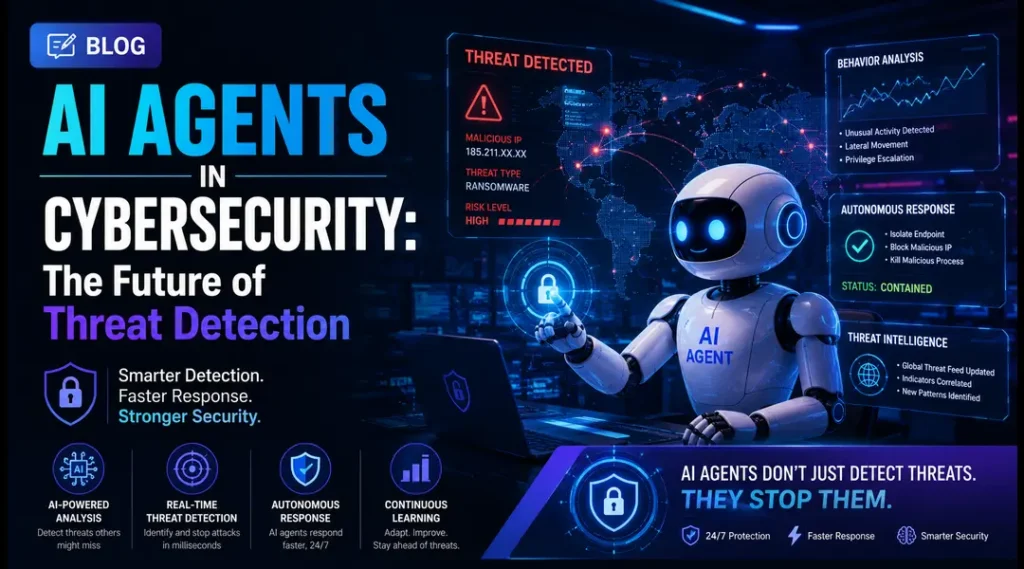
AI Agents in Cybersecurity are emerging as a powerful solution for improving threat detection and response. These intelligent systems can monitor security environments, analyze large amounts of data, identify unusual patterns, and help security professionals respond to potential risks more efficiently.
The future of cybersecurity is moving toward a combination of human expertise and AI powered assistance. AI agents are not replacing security professionals but helping them work faster, smarter, and more effectively.
What Are AI Agents in Cybersecurity?
AI agents in cybersecurity are intelligent software systems designed to perform security related tasks with minimal human involvement. They use artificial intelligence, machine learning, and automation capabilities to understand security data and take appropriate actions.
Unlike traditional security tools that follow fixed rules, AI agents can learn from new information and adapt to changing threats. They can analyze network activity, review security alerts, detect abnormal behavior, and provide recommendations based on collected data.
For example, an AI agent can monitor thousands of login attempts within seconds and identify patterns that may indicate a cyber attack. It can then alert security teams or trigger predefined security actions to reduce possible damage.
These capabilities make AI agents valuable for modern security environments where speed and accuracy are extremely important.
Why Traditional Cybersecurity Methods Are Not Enough
Cyber threats are becoming more complex every year. Organizations face challenges such as ransomware, phishing attacks, data breaches, and identity based attacks.
Traditional cybersecurity systems usually depend on predefined rules and signatures to detect known threats. While these methods are still useful, they may struggle with new or unknown attack techniques.
Some common challenges include:
Increasing Volume of Security Data
Modern businesses generate huge amounts of security information from networks, applications, devices, and cloud platforms. Human teams may find it difficult to analyze all this data manually.
AI agents can process large datasets quickly and identify important security signals that may otherwise be missed.
Faster Cyber Attacks
Many cyber attacks happen within minutes. Security teams need immediate visibility and rapid response capabilities.
AI powered systems can continuously monitor environments and help reduce the time between threat discovery and action.
Shortage of Cybersecurity Experts
The cybersecurity industry faces a shortage of skilled professionals. AI agents can support existing teams by handling repetitive tasks and improving operational efficiency.
How AI Agents Improve Threat Detection
AI Agents in Cybersecurity are changing the way organizations identify and manage threats. They provide several advantages that improve overall security operations.
Real Time Monitoring
AI agents can continuously observe networks, applications, and user activities. They analyze behavior patterns and detect unusual actions that may indicate a security problem.
For example, if an employee account suddenly accesses sensitive files from an unusual location, an AI agent can identify this behavior and generate an alert.
Advanced Threat Analysis
AI agents can examine multiple data sources together, including system logs, network traffic, and security alerts.
By connecting different pieces of information, they can identify relationships between events and provide a clearer understanding of potential attacks.
Automated Response
One of the biggest benefits of AI agents is their ability to support automated security responses.
Depending on the situation, an AI agent may help block suspicious activities, isolate affected systems, or recommend actions to security teams.
Automation helps organizations reduce response time and limit potential damage.
Predictive Security Capabilities
AI agents can analyze historical security data to identify patterns and predict possible risks.
This proactive approach allows organizations to strengthen their defenses before an attack occurs.
Key Applications of AI Agents in Cybersecurity
AI agents are being used across different areas of cybersecurity to improve protection and efficiency.
Security Operations Centers
Security Operations Centers handle thousands of alerts every day. AI agents can help security analysts prioritize important alerts and reduce unnecessary notifications.
This allows analysts to focus on serious threats that require human investigation.
Threat Intelligence
AI agents can collect and analyze information from different sources to provide better threat intelligence.
They can identify emerging attack methods and help organizations understand potential risks.
Incident Response
During a security incident, quick action is critical. AI agents can assist teams by analyzing affected systems, identifying attack paths, and suggesting response steps.
Identity Protection
AI agents can monitor user behavior and detect suspicious login patterns. This helps organizations prevent unauthorized access and protect sensitive information.
Benefits of Using AI Agents in Cybersecurity
The adoption of AI agents provides several benefits for organizations of all sizes.
Faster Detection
AI agents can analyze security events much faster than manual processes. Faster detection helps organizations respond before threats become more damaging.
Improved Accuracy
By analyzing large amounts of information, AI agents can identify patterns that may be difficult for humans to notice.
Better Security Efficiency
Security teams can use AI agents to automate repetitive tasks, allowing professionals to spend more time on strategic security activities.
Continuous Protection
Cyber threats can happen at any time. AI agents provide continuous monitoring and support, helping organizations maintain stronger security coverage.
Challenges and Limitations of AI Agents in Cybersecurity
Although AI agents provide many advantages, organizations should also understand their limitations.
Need for Human Oversight
AI systems can make mistakes or misunderstand situations. Human experts are still required to review important decisions and manage complex security incidents.
Data Quality Issues
AI agents depend on accurate and reliable data. Poor quality data can affect the accuracy of threat detection results.
Security Risks of AI Systems
Like any technology, AI systems can also become targets for attackers. Organizations need proper security controls to protect AI models and data.
Implementation Costs
Deploying advanced AI security solutions may require investment in technology, training, and infrastructure.
The Role of Humans in an AI Powered Security Future
The future of cybersecurity will not be only about artificial intelligence. Human expertise will continue to play an essential role.
Security professionals bring experience, critical thinking, and decision making skills that AI systems cannot fully replace.
The most effective approach is a partnership between humans and AI. AI agents can handle large scale analysis and automation, while cybersecurity experts focus on strategy, investigation, and complex problem solving.
Organizations that successfully combine both capabilities will have stronger protection against evolving cyber threats.
AI Agents and Future Cybersecurity Trends
The development of AI agents is closely connected with modern Cybersecurity Trends. Organizations are increasingly focusing on automation, proactive defense, cloud security, and intelligent threat management.
Future AI agents are expected to become more advanced with better reasoning abilities, improved accuracy, and stronger integration with cybersecurity platforms.
Some future developments may include:
Autonomous Security Operations
AI agents may handle more security monitoring and response tasks with limited human intervention while maintaining proper controls.
Improved Threat Prediction
Future systems may become better at identifying early warning signs before attacks happen.
Personalized Security Protection
AI agents may provide customized security recommendations based on an organization’s unique environment and risk profile.
How Businesses Can Prepare for AI Driven Cybersecurity
Organizations that want to benefit from AI agents should focus on a balanced implementation strategy.
Important steps include:
Build Strong Security Foundations
AI works best when organizations already have proper security processes, policies, and data management practices.
Train Security Teams
Employees should understand how AI tools work and how to use them effectively.
Maintain Human Control
Businesses should use AI as a support system while keeping human oversight for important security decisions.
Regularly Review Security Practices
Cybersecurity requires continuous improvement. Organizations should regularly evaluate their tools and update their security strategies.
Conclusion
AI Agents in Cybersecurity represent an important advancement in modern threat detection and security management. They help organizations analyze large amounts of data, identify threats faster, and improve response capabilities.
However, AI should not be viewed as a complete replacement for cybersecurity professionals. The strongest security approach combines artificial intelligence with human knowledge and experience.
As cyber threats continue to evolve, AI agents will become an increasingly valuable part of cybersecurity strategies. Organizations that adopt these technologies responsibly can improve their ability to protect valuable data, systems, and digital assets in the future.