
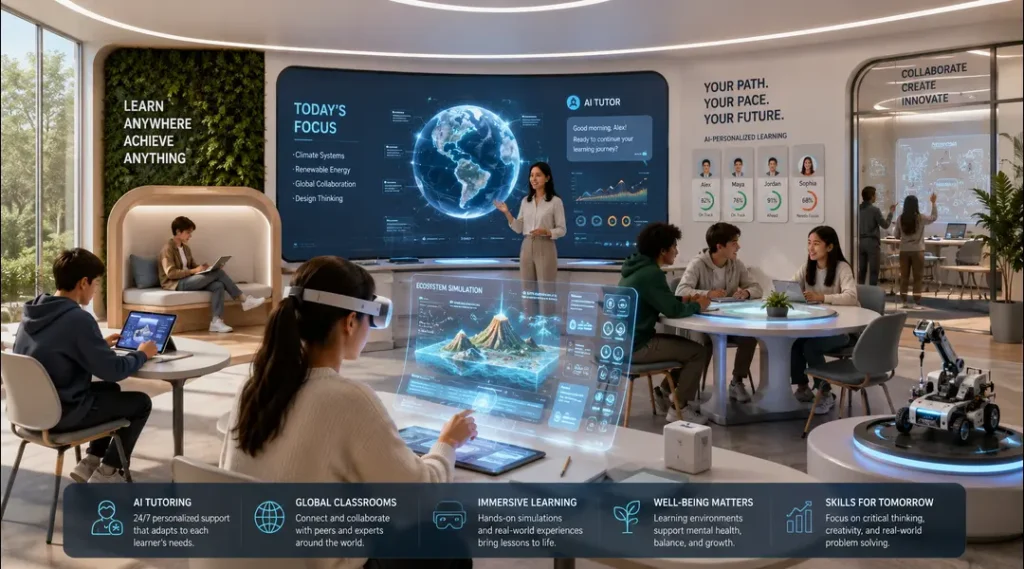
Imagine walking into a classroom ten years from now. There may still be teachers, books, desks, and students, but the way learning happens could look very different from today.
Students may learn through a combination of artificial intelligence, interactive digital tools, virtual experiences, collaborative projects, and personalized study plans. Instead of every student following exactly the same lesson at the same pace, technology could help create learning experiences that better match individual needs.
At the same time, education will not simply become more digital. The human side of learning could become even more important. Creativity, communication, critical thinking, collaboration, emotional awareness, and responsible decision making are skills that technology cannot replace easily.
The OECD has already emphasized student agency, well being, knowledge, skills, attitudes, and values as important parts of education beyond 2030.
So, what could education actually look like ten years from now? Here are some of the most realistic possibilities.
Artificial Intelligence Could Become a Learning Partner
Artificial intelligence is likely to become one of the biggest influences on education during the next decade.
Today, students already use AI tools to explain difficult concepts, generate ideas, practice languages, summarize information, and receive help with assignments. In the future, these tools could become more closely integrated into everyday learning.
Personalized AI Tutors
A student struggling with algebra might receive additional explanations, simpler examples, and extra practice. Another student who understands the topic quickly could move to more challenging problems.
An AI learning assistant could monitor progress and identify areas where a student needs more practice. It could also adjust explanations according to the student’s learning level and provide immediate feedback.
However, AI should support learning rather than replace teachers. The OECD’s 2026 work on AI literacy highlights the importance of helping students understand AI, evaluate its outputs critically, and use it responsibly and creatively.
This means future classrooms may teach students not only how to use AI, but also when to question it.
Learning Could Become More Personalized
The traditional classroom often requires many students to learn the same topic at roughly the same pace. Over the next ten years, personalized learning could become much more common.
Digital learning platforms can collect information about progress, practice, and performance. With responsible use of data, schools could use this information to identify where students need additional support.
A personalized learning experience could include different reading materials, practice exercises, video explanations, projects, and assessments based on individual needs.
This does not mean every student will study completely different subjects. Instead, the path toward understanding a subject could become more flexible.
Personalized education could also benefit students who need additional time or students who are ready for advanced material.
Classrooms Could Become More Interactive
The classroom of the future may be less focused on listening to a long lecture and more focused on doing, discussing, creating, and solving problems.
Interactive displays, simulations, educational applications, virtual reality, and augmented reality could help students experience concepts instead of simply reading about them.
Learning Through Virtual Experiences
Imagine studying ancient history by exploring a virtual version of an ancient city. A biology student could examine a detailed virtual ecosystem. A science student could perform a simulated experiment before entering a physical laboratory.
These experiences could make difficult concepts easier to understand and remember.
Technology will not make every lesson virtual. Physical classrooms and hands on activities will still have an important role. Instead, digital tools could provide additional ways to explore ideas that are difficult, expensive, dangerous, or impossible to experience directly.
Teachers Could Become Learning Guides
One of the biggest misconceptions about the future of education is that technology will eliminate teachers.
A more realistic possibility is that the role of teachers will evolve.
Teachers could spend less time delivering repetitive information and more time helping students understand complex ideas, develop confidence, collaborate with others, and apply knowledge to real situations.
The OECD Teaching Compass also emphasizes teacher agency, teacher well being, and teacher competencies as important elements of future education.
Human Skills Could Become More Valuable
Technology can provide information quickly, but teachers can understand classroom relationships, motivation, confusion, confidence, and individual circumstances in ways that automated systems may not fully understand.
A future teacher may therefore act more like a mentor, coach, facilitator, and learning designer.
The relationship between students and teachers could remain one of the most important parts of education.
Skills Could Matter More Than Memorization
Education has traditionally placed significant emphasis on remembering information and demonstrating knowledge through tests.
Memorization will still have value, but the ability to use knowledge could become even more important.
Students may increasingly be asked to solve problems, evaluate information, create projects, explain their reasoning, work in teams, and make responsible decisions.
The OECD’s future education framework focuses on competencies that include knowledge, skills, attitudes, and values, rather than treating education as simple information delivery.
Future Ready Skills Students May Need
Critical thinking could help students identify unreliable information.
Creativity could help them develop new ideas and solutions.
Communication could help them work effectively with people.
Collaboration could prepare them for workplaces where projects are rarely completed by one person alone.
Digital literacy could help students understand technology and use it responsibly.
AI literacy could become increasingly important as AI systems become part of everyday life.
These skills could become central to the future education system.
Assessments Could Change
Exams are unlikely to disappear completely, but assessment could become more diverse.
Instead of relying primarily on one final examination, schools may use projects, presentations, portfolios, practical tasks, classroom participation, simulations, and continuous assessments.
Real World Projects
A student studying environmental science could work on a local sustainability project. A mathematics student could use mathematics to solve a practical budgeting problem. A language student could create a presentation for a real audience.
These approaches could show not only whether a student knows something, but also whether the student can apply that knowledge.
AI could also help teachers analyze learning patterns and identify areas that need attention. However, assessment systems will need strong safeguards around privacy, fairness, transparency, and appropriate use of technology. The OECD has specifically highlighted these issues when discussing trustworthy generative AI in education.
Education Could Become More Accessible
Technology could also make learning more accessible to people who face geographic, financial, physical, or scheduling barriers.
Online courses, digital libraries, recorded lessons, language tools, accessibility features, and remote classrooms could allow more people to learn from different locations.
A student who cannot easily attend a traditional classroom could potentially access lessons from home. An adult working full time could study during evenings or weekends.
This could support a broader culture of lifelong learning.
However, technology alone cannot guarantee equal access. Internet connectivity, devices, teacher support, affordability, and digital skills will remain important factors. The future of education will depend not only on better technology but also on making useful technology available responsibly and fairly.
Lifelong Learning Could Become Normal
The idea of finishing education in your early twenties and then relying on the same knowledge for an entire career may become increasingly unrealistic.
Technology, industries, and job requirements continue to change. People may need to learn new tools and skills throughout their working lives.
This could make short courses, professional certificates, online learning, workplace training, and skill based education more important.
Instead of thinking of education as something that ends after school or university, people may increasingly see learning as an ongoing part of life.
The OECD’s work on future skills reflects this broader need to prepare people for changing work and social environments.
Education Could Become More Connected to Real Life
Future education may also focus more strongly on practical problems.
Students could work on projects involving climate change, technology, entrepreneurship, health, financial literacy, community development, and other real world challenges.
This could help students understand why they are learning something and how that knowledge can be used outside the classroom.
The OECD’s learning framework encourages students to develop agency and learn how to navigate unfamiliar situations rather than simply follow fixed instructions.
That approach could become increasingly valuable in a world where many future problems cannot be predicted today.
The Human Side of Education Will Still Matter
Even with advanced AI and digital classrooms, education will remain a human experience.
Students need encouragement, friendship, discussion, teamwork, creativity, and meaningful relationships. They need opportunities to make mistakes, ask questions, build confidence, and discover their interests.
Technology can support these experiences, but it should not replace them.
In fact, as technology becomes more powerful, human qualities may become even more important. Students will need to understand not only what technology can do, but also how their choices affect other people.
This is why future education should balance digital innovation with human development.
What Education May Look Like in 2036
Ten years from now, there probably will not be one single model of education.
Some schools may use advanced AI systems extensively. Others may prefer traditional approaches with selected digital tools. Universities, vocational institutions, online platforms, and workplaces may all develop different learning models.
Still, several broad trends are likely to influence the next decade.
Students could receive more personalized learning support.
AI could become a regular learning assistant.
Teachers could focus more on mentoring and higher level learning.
Classrooms could use more interactive and immersive technology.
Assessments could include more practical projects.
AI literacy and digital literacy could become essential.
Critical thinking and creativity could receive greater attention.
Lifelong learning could become a normal part of professional life.
These changes are not guaranteed, but they align with current research and policy discussions about the skills, technologies, and learning environments needed for the coming years.
The Future of Education Is About More Than Technology
When people imagine the Future of Education, they often picture robots, virtual reality, and AI powered classrooms.
Technology will certainly be part of the story, but it is only one part.
The bigger question is what education should help people become.
Students will need knowledge, but they will also need curiosity. They will need technical skills, but they will also need judgment. They will need to work with AI, but they will also need to understand its limitations.
The most successful education systems may therefore be the ones that combine technology with strong teachers, meaningful learning experiences, practical skills, and human values.
Final Thoughts
How education could look 10 years from now is impossible to predict with complete certainty. Technology will continue to evolve, and new challenges will emerge that we cannot fully anticipate today.
What we can see already is the direction of change.
Education is moving toward more personalized learning, greater use of digital technology, stronger emphasis on practical skills, and a growing need for AI and digital literacy. At the same time, teachers, human relationships, critical thinking, creativity, and responsible decision making will remain essential.
The classroom of 2036 may look different from the classroom of today, but the purpose of education can remain the same: helping people learn, grow, think independently, and contribute meaningfully to the world around them.
The best future education system may not be the one with the most technology. It may be the one that uses technology wisely while keeping people at the center of learning.