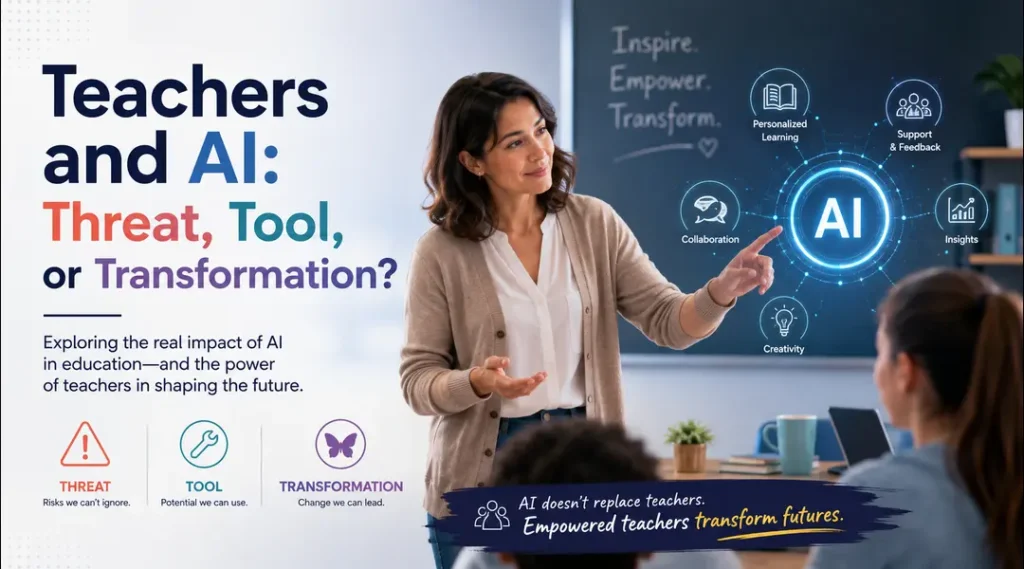
Artificial intelligence is changing the way people work, communicate, create, and learn. Education is no exception. As AI tools become easier to access, teachers are facing an important question: should artificial intelligence be seen as a threat, a useful tool, or something that could transform the entire teaching profession?
The answer is more balanced than it may first appear.
Teachers and AI do not necessarily have to compete with each other. When used responsibly, AI can support teachers with everyday tasks, help create more personalized learning experiences, and give educators more time to focus on what technology cannot easily replace: human connection, judgment, encouragement, and understanding.
At the same time, AI brings real concerns. Accuracy, student privacy, academic integrity, bias, overreliance on technology, and the changing nature of teaching all deserve serious attention.
The future of education will likely not be about choosing between teachers and technology. Instead, it will be about learning how teachers and AI can work together effectively.
Why Are Teachers Paying Attention to AI?
AI in education has moved from an interesting idea to a practical part of everyday conversations.
Teachers can now use AI tools to brainstorm lesson ideas, create classroom activities, generate practice questions, simplify complex explanations, organize information, and develop different versions of learning materials.
This does not mean every teacher needs to become an AI expert.
It means educators need to understand where AI can provide useful assistance and where human expertise remains essential.
For example, an AI tool might quickly suggest ten questions about a science topic. A teacher can then review those questions, remove anything inaccurate, adjust the difficulty, and select the questions that actually fit the students.
The teacher remains the decision maker.
That distinction is important because AI can produce information that sounds convincing while still being incorrect or incomplete. Teachers bring subject knowledge and classroom experience that help them evaluate whether an AI generated result is appropriate.
AI as a Tool for Teachers
One of the most practical ways to understand AI in education is to think of it as an assistant.
A teacher already has many responsibilities beyond standing in front of a classroom. Lesson planning, creating worksheets, preparing assessments, writing instructions, organizing resources, communicating with families, and adapting activities can consume significant time.
AI can help with some of these repetitive tasks.
Lesson Planning
Teachers can use AI to brainstorm lesson structures, classroom activities, discussion questions, examples, and project ideas.
For instance, a teacher preparing a lesson about climate change could ask an AI tool to suggest activities for different learning levels. The teacher can then review the suggestions and adapt them according to the curriculum and the needs of the class.
The benefit is not simply speed. It can also help teachers explore approaches they may not have considered.
Creating Learning Materials
AI tools can assist with creating quizzes, vocabulary exercises, summaries, writing prompts, and practice activities.
Teachers can also ask AI to explain a difficult concept in simpler language or create examples suitable for a particular age group.
However, these materials should always be reviewed before reaching students. Teachers should check facts, language, difficulty, cultural context, and whether the material actually supports the learning objective.
Supporting Personalized Learning
Every classroom contains students with different strengths, interests, learning speeds, and levels of prior knowledge.
AI can support personalized learning by helping teachers create different versions of an activity.
A teacher might prepare a basic explanation for students who need additional support and a more challenging extension activity for students who are ready to go further.
This does not replace individualized teaching. Instead, it can give teachers another way to create learning resources for diverse classrooms.
Can AI Replace Teachers?
This is one of the biggest concerns surrounding artificial intelligence in education.
AI can generate text, answer questions, provide explanations, and perform many tasks quickly. But teaching involves far more than delivering information.
A good teacher notices when a student is confused even when the student does not ask for help. A teacher can recognize frustration, build confidence, manage classroom relationships, encourage curiosity, and understand the social and emotional context behind a student’s behavior.
These human elements matter.
Education is also not simply about finding the correct answer. Students need to learn how to ask meaningful questions, communicate, collaborate, think critically, solve problems, and make responsible decisions.
AI can support some of these activities, but it does not remove the need for human guidance.
Rather than asking whether AI will replace teachers, a better question may be: how can teachers use AI to become more effective?
The Risks of Using AI in the Classroom
The advantages of AI are meaningful, but responsible use requires awareness of its limitations.
AI Can Make Mistakes
AI systems can generate incorrect information. Sometimes an answer may look professional and confident even when the information is wrong.
For this reason, teachers should treat AI generated content as material to review rather than unquestionable authority.
Fact checking remains important, particularly in subjects where accuracy matters.
Student Privacy Matters
Teachers and schools should think carefully about what information is entered into AI systems.
Personal student information, confidential records, private communications, or sensitive details should not be shared with an AI service unless the school has appropriate policies and protections in place.
Responsible AI use begins with protecting students.
Academic Integrity Is Changing
AI has also changed conversations around homework, essays, research, and assessment.
If students can generate an assignment with an AI tool, traditional homework may not always show what a student actually understands.
Schools may therefore need to rethink assessment methods.
Teachers can place greater emphasis on classroom discussions, projects, presentations, drafts, reflections, practical work, and activities where students explain their reasoning.
The goal should not simply be to catch students using AI. It should be to design learning experiences where students develop genuine understanding and use technology responsibly.
AI Can Help Teachers Save Time
Teacher workload is a major reason AI tools are attracting attention.
Imagine a teacher who spends an evening creating several versions of a reading activity. An AI tool might help generate an initial structure in minutes.
That saved time can then be used for something more valuable, such as reviewing student work, planning a meaningful classroom discussion, speaking with a student who needs support, or preparing a creative activity.
This is where teacher productivity becomes an important benefit of AI.
The goal should not be to make teachers work faster so they can simply do more work.
The better goal is to reduce repetitive tasks so teachers can spend more time on high value activities.
What Skills Will Teachers Need?
As AI becomes part of education, teachers will need more than technical skills.
AI literacy will become increasingly useful.
Teachers should understand how AI systems can be used, what their limitations are, how to evaluate generated information, and how to protect student privacy.
Critical thinking will be just as important as knowing which button to press.
AI Literacy
Teachers should be comfortable experimenting with AI tools while maintaining professional judgment.
They should know how to write clear instructions for AI systems, evaluate the quality of responses, identify possible errors, and improve generated materials.
Digital Citizenship
Students also need guidance.
Teachers can help students understand responsible AI use, including attribution, originality, privacy, misinformation, and appropriate use of technology.
Students should learn that using AI is not automatically good or bad. What matters is how and why it is used.
Human Skills
Communication, empathy, creativity, collaboration, leadership, and critical thinking will remain essential.
In fact, these skills may become even more valuable as technology becomes better at producing routine information.
How Schools Can Introduce AI Responsibly
Schools do not need to transform everything overnight.
A practical approach is to start with clear goals.
First, identify tasks where AI can provide genuine value. This could include brainstorming lesson ideas, creating practice materials, or helping teachers adapt explanations.
Next, establish clear rules for privacy and responsible use.
Teachers should also have opportunities to learn from one another. Professional development does not always need to be a formal technology course. Teachers can share practical examples of what worked, what failed, and what required significant human review.
Most importantly, schools should keep learning outcomes at the center.
Technology should support education rather than become the purpose of education.
Teachers and AI Can Work Together
The relationship between teachers and AI does not have to be a competition.
Think about AI as a tool that can handle certain tasks while teachers remain responsible for the educational decisions.
AI may generate an activity.
The teacher decides whether that activity is suitable.
AI may suggest an explanation.
The teacher checks whether it is accurate and appropriate for the students.
AI may provide several ideas.
The teacher chooses the one that best fits the classroom.
This human plus technology approach can make AI much more useful.
What Does the Future of Education Look Like?
The Future of Education will probably involve more technology, but technology alone will not determine what learning becomes.
The most successful classrooms may be those where technology and human teaching complement each other.
Students may use AI as a learning assistant while teachers guide them toward deeper understanding. Teachers may use AI to reduce repetitive work while spending more time mentoring students.
Assessment may become more focused on reasoning and practical application. Digital literacy may become a core part of education. And teachers may increasingly become guides who help students navigate an environment filled with rapidly changing information.
The important thing is to avoid treating AI as either a miracle solution or a disaster.
It is a powerful technology with both opportunities and limitations.
The Bottom Line
So, are teachers and AI facing a threat, discovering a new tool, or entering a period of transformation?
It is a little of all three.
AI can create challenges for educators, especially around assessment, privacy, accuracy, and academic integrity. But it can also become a valuable tool for lesson planning, content creation, personalized learning, and teacher productivity.
The biggest opportunity is transformation.
Teachers who understand AI can use it thoughtfully without giving up the human qualities that make education meaningful. AI can help with tasks, but teachers provide context, judgment, relationships, and purpose.
The future of teaching is unlikely to be about humans versus machines.
It is more likely to be about humans using technology wisely.
When teachers remain at the center of educational decisions and AI is used as responsible support, technology can become more than a shortcut. It can become a practical partner in creating better learning experiences.