Cloud computing and edge computing are two important ways of processing and managing digital data. Cloud platforms give businesses flexible access to computing power, storage, databases, and software through remote data centers. Edge computing moves some processing closer to the people, devices, and machines that create the data.
So, which one is the future? The answer is not as simple as choosing cloud or edge. Cloud computing will remain essential for large scale storage, analytics, application development, and centralized management. At the same time, edge computing is becoming increasingly important for applications that need fast responses, local processing, and reliable operation.
Understanding the difference between cloud and edge computing can help businesses choose the right architecture for their applications, connected devices, and artificial intelligence projects.
What Is Cloud Computing?
Cloud computing is a model where computing resources are delivered over the internet instead of being hosted entirely on local computers or private servers. These resources can include virtual machines, storage, databases, networking, analytics platforms, and software applications.
One of the biggest advantages of cloud computing is flexibility. A company can increase or decrease computing resources as its needs change without purchasing large amounts of physical hardware.
Cloud services are also useful for teams that need centralized access to applications and data. Employees in different locations can work with the same systems, while developers can create, test, and deploy applications using managed infrastructure.
Key Benefits of Cloud Computing
Scalability: Resources can be adjusted as demand changes.
Cost efficiency: Businesses can reduce the need for large upfront hardware investments.
Centralized management: Data, applications, and infrastructure can be managed from a central environment.
Backup and recovery: Cloud services can support data backup and disaster recovery strategies.
Global access: Applications can serve users across different regions through distributed cloud infrastructure.
What Is Edge Computing?
Edge computing is a distributed computing approach that processes data closer to where it is generated or where it is needed. Instead of sending every piece of data to a distant cloud data center, some processing can happen on devices, gateways, local servers, or other edge locations.
This approach is especially useful when applications need quick responses. For example, an industrial machine may need to react to sensor information immediately. Sending every sensor reading to a remote data center and waiting for a response could introduce unnecessary delay.
Edge computing can also reduce the amount of data sent to the cloud. A local system can analyze raw information and send only important results to a central platform.
Common edge computing use cases include smart factories, connected vehicles, healthcare devices, retail systems, video analytics, telecommunications, and Internet of Things applications.
Cloud Computing vs. Edge Computing: Key Differences
The main difference is where data processing happens.
Cloud computing generally processes data in centralized or distributed data centers. Edge computing processes at least part of the workload closer to the source of the data.
Latency is another important difference. Cloud systems can provide excellent performance, but data may need to travel between a device and a remote data center. Edge computing can reduce this distance, making it useful for applications where milliseconds can matter.
Data management also differs. Cloud environments are well suited to centralized storage and large scale analytics. Edge environments are better suited to local processing, filtering, and immediate decision making.
Here is a simple comparison:
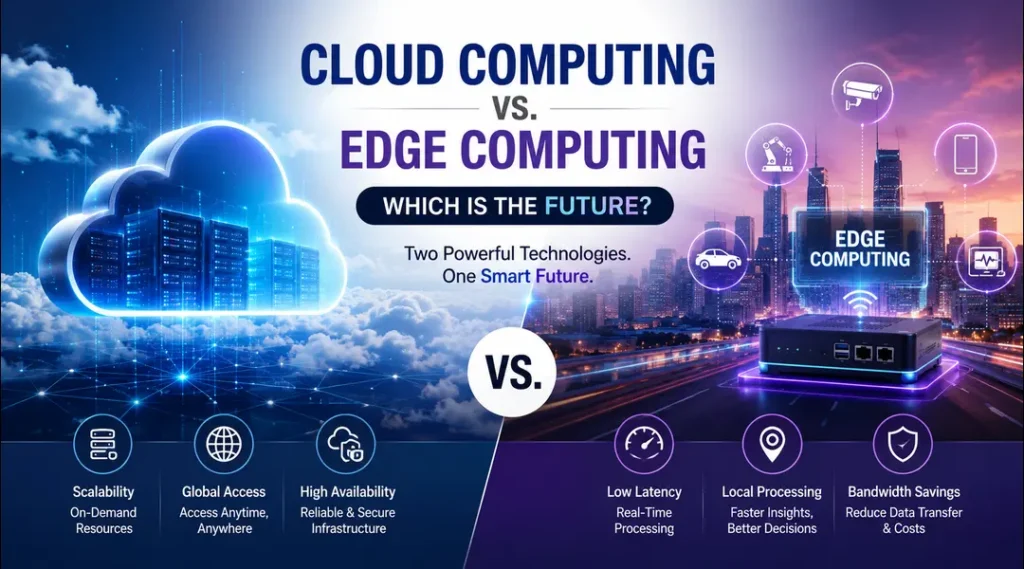
Cloud computing focuses on centralized processing, large scale storage, flexible resources, and broad application management.
Edge computing focuses on local processing, lower latency, real time responses, and reduced data movement.
Neither approach is automatically better. The right choice depends on the application’s requirements.
Advantages of Cloud Computing
Cloud computing remains a strong choice for many organizations because it provides mature infrastructure and a broad range of services.
For software development, cloud platforms can provide databases, application hosting, machine learning tools, analytics, security services, and development environments in one ecosystem.
Cloud computing is particularly valuable when an organization needs to store and analyze large volumes of historical data. A company can collect information from multiple locations and use centralized systems to identify patterns, generate reports, or train machine learning models.
Cloud computing also supports collaboration. Teams can access shared applications and resources without maintaining separate infrastructure for every location.
However, cloud computing can face challenges when applications depend heavily on continuous connectivity or extremely low latency. Data transfer can also create bandwidth costs and privacy considerations, depending on the workload.
Advantages of Edge Computing
The main strength of edge computing is proximity. Processing data closer to its source can improve response time and reduce dependence on a remote connection.
For example, an automated manufacturing system may need to detect a problem and stop a machine immediately. An edge device can analyze sensor data locally and trigger an action without waiting for a cloud response.
Edge computing can also improve resilience. If a local connection to the cloud becomes unavailable, an edge system may continue performing important local functions, depending on how the application is designed.
Another benefit is bandwidth optimization. Instead of continuously sending raw video, sensor readings, or other high volume data to the cloud, an edge system can filter and process information locally before sending selected data to a central platform.
The tradeoff is that edge environments can be more difficult to manage at scale. Organizations may need to secure, update, monitor, and maintain many distributed devices and local systems.
Why the Future Is Likely Hybrid
The most practical future is not cloud versus edge. It is a combination of both.
A hybrid architecture can allow edge systems to handle time sensitive processing while cloud platforms manage centralized storage, large scale analytics, model training, application management, and long term insights.
Consider a smart factory. Sensors and cameras can generate large amounts of information. Edge systems can detect unusual machine behavior locally and respond quickly. The cloud can receive selected information, store historical records, compare data across factories, and support advanced analytics.
This model combines the strengths of both technologies.
Artificial Intelligence and Edge Computing
Artificial intelligence is another reason edge computing is gaining attention. AI systems often require significant computing resources, but not every AI task needs to send data to a distant server.
AI at the edge can support applications such as image recognition, predictive maintenance, voice processing, fraud detection, and intelligent monitoring. Local processing can reduce response time and may also help organizations limit the movement of sensitive data.
At the same time, cloud computing remains important for AI. Large models may require substantial computing power for training, evaluation, storage, and centralized management. This makes cloud and edge computing complementary technologies for many AI workloads.
Organizations also need strong security controls as AI and distributed systems become more connected. Businesses exploring this area can also learn about AI Agents in Cybersecurity to understand how intelligent systems may support security monitoring, threat detection, and response.
Which Is Better for Businesses?
There is no universal winner in the Cloud Computing vs. Edge Computing discussion.
Cloud computing may be a better fit when a business needs centralized infrastructure, large storage capacity, scalable application hosting, advanced analytics, or global access.
Edge computing may be a better fit when an application needs low latency, local decision making, limited connectivity, or reduced data transfer.
Many businesses will benefit from using both. The cloud can provide the central intelligence and long term data platform, while edge systems can handle immediate decisions near users and devices.
Before choosing an architecture, businesses should consider several questions:
How quickly must the application respond?
Applications that require immediate reactions may benefit from processing data closer to the source.
How much data is generated at the source?
Large volumes of video, sensor information, or machine data may make local processing more practical.
Does the application need to work when connectivity is limited?
If continuous internet access is not guaranteed, local processing can provide additional resilience.
Where should sensitive data be processed?
Businesses should evaluate privacy, security, regulatory requirements, and data handling practices before deciding where processing should occur.
How will devices and edge locations be secured and updated?
Distributed systems can increase operational complexity, so device management, software updates, access controls, monitoring, and security should be part of the architecture from the beginning.
What are the long term infrastructure and operational costs?
The lowest initial cost is not always the lowest total cost. Businesses should consider hardware, connectivity, cloud resources, maintenance, security, monitoring, and staff requirements.
Answering these questions is more useful than choosing a technology simply because it is popular.
The Future of Cloud and Edge Computing
The future will likely be defined by distributed computing rather than a complete move away from the cloud.
As connected devices, automation, artificial intelligence, and real time applications continue to grow, more processing will happen closer to users and machines. At the same time, centralized cloud infrastructure will remain important for data management, large scale computation, application development, and coordination.
This creates a more connected technology environment where cloud platforms and edge locations work together.
Businesses should therefore think about architecture as a spectrum. Some workloads may run almost entirely in the cloud. Others may require substantial local processing. Many modern applications will divide workloads between both environments.
Final Thoughts
Cloud Computing vs. Edge Computing is not really a battle between two competing technologies. It is a question of where each workload should be processed to deliver the best combination of speed, cost, scalability, reliability, security, and user experience.
Cloud computing is likely to remain the foundation for centralized services, storage, analytics, and large scale computing. Edge computing will continue to grow where real time processing and local decision making are important.
For many organizations, the strongest strategy will be a hybrid approach. Use the cloud for what it does best and use edge infrastructure where proximity and fast responses provide clear value.
The future of computing is therefore likely to be both cloud and edge, working together to create faster, smarter, and more flexible digital systems.